

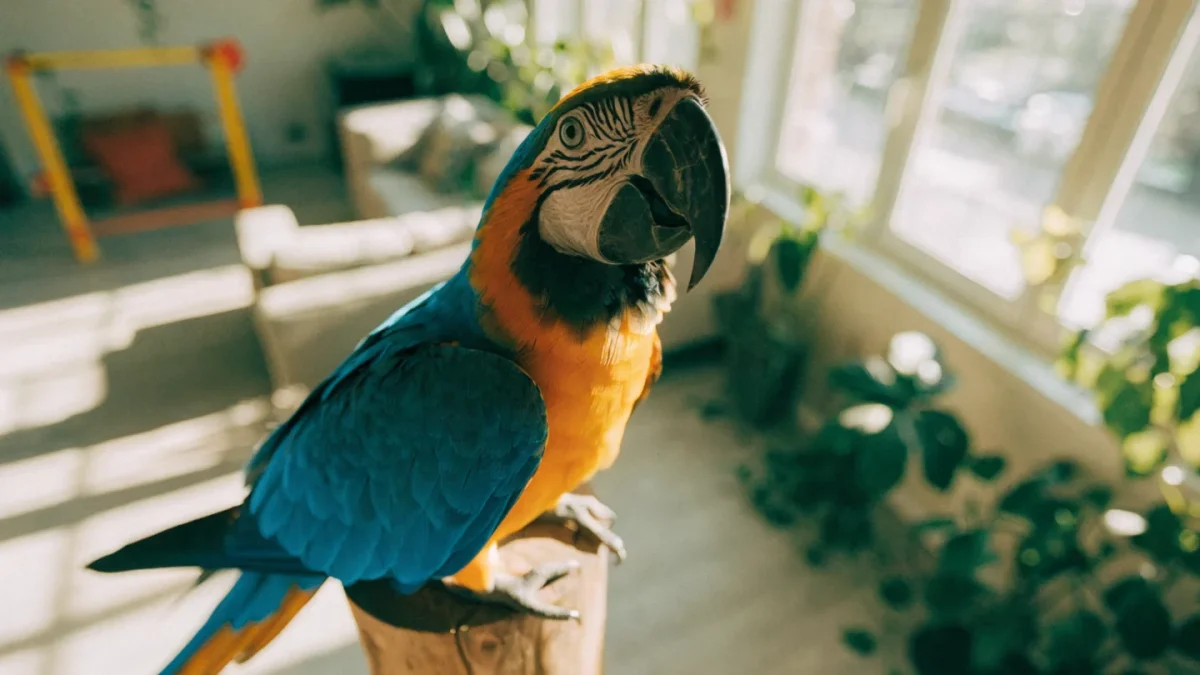
The first large parrot I ever handled was an umbrella cockatoo named Chowder. I was seventeen, volunteering at a rescue facility, and nobody warned me about the bite pressure. Chowder latched onto my thumb, looked me dead in the eye, and squeezed until I saw stars. I didn't flinch — not because I was tough, but because I was so stunned I forgot how to move. The handler next to me just said, "Yeah, she does that to everyone the first time."
Large parrots — African Greys (Psittacus erithacus), macaws (Ara species), and cockatoos (Cacatua species) — need spacious housing, a varied diet centered on pellets and fresh foods, daily social interaction measured in hours rather than minutes, and an owner who understands that these birds live 40 to 80 years. They're intelligent, emotional, loud, messy, and deeply rewarding, but only if you go in knowing exactly what the next several decades look like.
What Counts as a "Large Parrot"
The term gets thrown around loosely, so I'll be specific. I'm talking about birds with body lengths above 30 cm and the temperament complexity to match. African Greys weigh around 400-500 grams and are compact compared to macaws, but their cognitive demands are enormous. Blue-and-gold macaws can reach 85 cm from head to tail tip and weigh over a kilogram. Moluccan cockatoos sit somewhere in between but produce noise that makes macaws sound reasonable.
These aren't scaled-up versions of budgies or cockatiels. The difference between a cockatiel and a cockatoo isn't just size — it's the gap between a goldfish and a border collie in terms of social needs, destructive capability, and emotional volatility.
I group them together in a care guide because they share certain baseline requirements: large enclosures, complex diets, extensive socialization, and the kind of veterinary care that only avian specialists can provide. But each genus has its own personality quirks and care nuances, which I'll get into.
Housing: Bigger Than You Think
Every first-time large parrot owner underestimates enclosure size. Every single one.
The cage itself is a starting point, not a destination. An African Grey needs a cage at minimum 90 cm wide, 60 cm deep, and 120 cm tall — but that's for sleeping and eating. The bird shouldn't live in it all day. Macaws need even more. A hyacinth macaw in a standard "large parrot cage" looks like a Great Dane in a studio apartment. And I've walked through pet stores where they sell these cages as suitable. They're not.
Bar spacing matters more than people realize. For African Greys, 19-25 mm bar spacing works. For macaws, 25-38 mm. Too wide and a Grey can get its head stuck. Too narrow and a macaw will bend the bars — I've seen a green-winged macaw peel apart welded bar joints with its beak during what appeared to be casual boredom.
Placement in the home changes everything. Put the cage in a high-traffic area where the bird can observe household activity without being startled from behind. Back against a wall, at chest height. Avoid kitchens — PTFE-coated cookware fumes can kill a parrot in minutes, and even normal cooking fumes aren't great. I lost a friend's bird to this. A holiday dinner, a nonstick pan left on the burner, and a cockatiel in the next room was dead before anyone noticed the connection. It happens with large parrots too.
Out-of-cage time is non-negotiable. A play stand or a dedicated bird room gives your parrot space to move, forage, and interact on its own terms. Most keepers I know who maintain healthy large parrots have a setup where the bird spends 4-6 hours outside the cage daily, supervised.
Diet: The Seed Myth and What Actually Works
If someone tells you a large parrot can thrive on a seed-based diet, walk away from that advice. Seeds are high in fat and low in most of the vitamins and minerals these birds need. An all-seed diet in a macaw is like feeding a person nothing but trail mix for forty years — something will break down.
The foundation should be a formulated pellet — roughly 50-70% of the diet depending on the species. African Greys do well on a pellet-heavy diet supplemented with calcium-rich vegetables because they're prone to hypocalcemia. Macaws need a higher fat content than Greys, so they get more nuts — almonds, walnuts, Brazil nuts in the shell. Cockatoos gain weight easily and need the leanest diet of the three.
Fresh vegetables daily: dark leafy greens (kale, dandelion greens, Swiss chard), orange vegetables (sweet potato, carrots, butternut squash), peppers, snap peas, broccoli. Fruits in moderation — they love grapes and berries, but fruit sugar adds up.
A few foods to avoid entirely: avocado (toxic), chocolate (toxic), caffeine, alcohol, and anything with high salt content. Onions and garlic are debated, but I don't feed them and don't recommend it.
I spent three months converting an eighteen-year-old African Grey named Dizzy from an all-sunflower-seed diet to pellets. The previous owner had fed nothing but seeds for the bird's entire life. Dizzy's feathers were dull, his beak was overgrown, and his bloodwork showed dangerously low calcium. The conversion involved mixing pellets into dampened seeds, gradually increasing the ratio, and using nutrient-rich vegetables as treats to bridge the gap. He fought me on it for weeks. But within six months of the diet change, his feather quality transformed.
Socialization and Mental Stimulation
Here's where large parrot care either works or collapses.
These birds are flock animals with cognitive abilities comparable to a 4-5 year old human child — at least in African Greys, which are the most studied. They need social interaction the way you need conversation. Isolation doesn't just make them unhappy; it makes them psychologically unwell. Feather plucking, screaming, aggression, self-mutilation — these are symptoms of a bored, lonely, or stressed parrot, and they're disturbingly common.
Different species express social needs differently. African Greys tend to bond deeply with one person and can become anxious or aggressive around others. Cockatoos crave physical affection — cuddling, preening, being held — to a degree that becomes problematic if you can't sustain it every single day. Macaws are often more socially flexible but need physical space to move and play.
I recommend a minimum of two hours of direct interaction daily — talking, training, playing — plus additional out-of-cage time where the bird can observe and participate in household activity. Training sessions using positive reinforcement (target training, simple tricks, recall) provide mental exercise and strengthen the human-bird bond. Fifteen minutes of focused training is worth more than an hour of the bird sitting on your shoulder while you watch television.
For keepers who work full-time jobs outside the home, a large parrot is genuinely difficult to keep well. I say this knowing it's not what people want to hear. If the bird spends ten hours alone five days a week, you need a plan — a second bird (which comes with its own complexity), a dedicated enrichment routine, background noise, foraging setups that keep the bird occupied. Even then, some species — particularly cockatoos — will struggle.
Species-Specific Considerations
African Greys are the intellectuals of the parrot world. They pick up vocabulary and contextual speech faster than any other species, but they're also the most neurotic. They stress easily, they're cautious with new objects and people, and they respond to household tension. I've seen Greys start plucking during a owner's divorce — the bird picked up on the emotional shift before anyone addressed it. They need routine, predictability, and patience.
Macaws are the athletes. They need the most physical space, they play hard, and they're louder than most people can imagine until they've been in a room with one. A blue-and-gold macaw in full contact call can hit 105 decibels — that's chainsaw territory. But they're also goofy, playful, and often more adaptable to changes in environment and schedule than Greys or cockatoos. Their beak pressure is the highest of the three groups. Respect it.
Cockatoos are the emotional sponges. They bond harder than any parrot I've worked with, which makes them both the most affectionate and the most demanding. A well-adjusted cockatoo is an absolute joy — affectionate, funny, endlessly entertaining. An under-stimulated cockatoo is a screaming, plucking, biting mess, and rescue facilities are full of them. I always tell people considering a cockatoo to visit a rescue first. Spend an afternoon with one. Then decide.
If you're keeping medium-sized parrots like conures and caiques and considering an upgrade to a large species, understand that the jump in care requirements isn't proportional to the size increase. It's exponential.
Veterinary Care
Large parrots need an avian veterinarian, not just any vet who'll see birds. The difference matters. Avian vets have specific training in bird anatomy, anesthesia protocols for avian patients, and experience recognizing the subtle signs of illness that parrots are hardwired to hide.
Annual wellness exams should include a physical assessment, bloodwork (complete blood count plus biochemistry panel), and a gram stain of the crop or choana. Some vets recommend annual X-rays for older birds, particularly for species prone to atherosclerosis like Amazon parrots and cockatoos.
Watch for: changes in droppings (color, consistency, volume), fluffed feathers during the day, reduced appetite, changes in vocalization, discharge from nares or eyes, and any shift in behavior. Parrots are prey animals. They hide illness until they physically can't anymore, which means by the time you notice something's wrong, the bird may have been sick for days or weeks.
I keep a gram scale near my Grey's cage and weigh him every Monday morning. A 10% body weight drop over a week or two is a vet visit, no questions asked. This habit caught an early aspergillosis infection three years ago that could have been fatal if I'd waited for visible symptoms.
The Commitment Question
A blue-and-gold macaw hatched in 2026 has a reasonable chance of living until 2086 or later. That's not an exaggeration. Cockatoos regularly reach 60. African Greys commonly hit 50.
This means care planning involves estate planning. I'm not being dramatic — I have a provision in my will for my Grey. Many large parrot owners eventually face the reality of finding a home for a bird that will outlive them. The bird may also outlive your interest, your living situation, your marriage, and your patience. Rescue facilities are overwhelmed with large parrots surrendered by owners who didn't understand the timeline.
Before you bring a large parrot home, answer honestly: Can you provide 4-6 hours of daily attention for the next 40-60 years? Can you afford annual avian vet visits plus emergencies? Can you tolerate noise levels that will change how your neighbors feel about you? Do you have a succession plan for the bird if something happens to you?
If any of those answers are uncertain, that's okay. There are wonderful parrot species that require less time, space, and lifespan commitment. And there's no shame in deciding a large parrot isn't the right fit.
Quick-Reference Care Parameters
| Parameter | African Grey | Macaw (Blue-and-Gold) | Cockatoo (Umbrella) |
|---|---|---|---|
| Lifespan | 40-60 years | 50-70+ years | 40-70 years |
| Min. cage width | 90 cm | 120 cm | 90 cm |
| Diet base | 60-70% pellets | 50-60% pellets | 60-70% pellets |
| Noise level | Moderate-high | Very high | Very high |
| Handling ease | Moderate | Moderate-hard | Variable |
| Vet frequency | Annual minimum | Annual minimum | Annual minimum |
FAQ
Do large parrots need another bird for company?
Not necessarily in the way people mean. A second parrot doesn't replace human interaction — Greys in particular bond to humans, not other Greys. A companion bird can help with daytime loneliness for owners who work, but introducing two large parrots carries real risks: aggression, jealousy, and doubled cost and noise. I've seen it work beautifully, and I've seen a macaw break another macaw's beak in a cage dispute. If you're getting a second bird to solve a behavior problem, you're more likely to have two birds with behavior problems.
Can I let my parrot fly freely in my house?
Indoor flight is excellent for exercise and mental health, but the room must be bird-proofed: ceiling fans off, windows and mirrors covered or marked, no open water, no toxic plants, and absolutely no access to the kitchen. I let my Grey have supervised flight time in one room with the door closed. Full-house free flight works for some people, but the risk of escape through an open door or window is constant. Clipping is a personal choice — I don't do it, but I understand why some owners choose to.
How loud are large parrots really?
Louder than any description prepares you for. Macaws can exceed 105 decibels, which is louder than a motorcycle engine. Cockatoos aren't far behind. African Greys are the quietest of the three but still produce alarm calls that'll jolt you out of sleep. Large parrots vocalize most at dawn and dusk — this is biological, not trainable. You can reduce excessive screaming through environmental management, but you cannot have a silent large parrot. If noise is a dealbreaker, these are not the right birds.
What's the biggest mistake new large parrot owners make?
Underestimating the time commitment. People research the cage, the diet, the toys — and then don't account for the three to six hours of daily attention the bird actually needs. A bored, under-stimulated large parrot develops behavioral problems that are incredibly difficult to reverse. The second biggest mistake is buying the bird on impulse at an expo or pet store without having the enclosure and avian vet already arranged.
Are large parrots good with children?
That depends entirely on the bird, the child, and the supervision. A macaw can break a finger. An African Grey can deliver a bite that requires stitches. I wouldn't leave any large parrot unsupervised with a child under twelve, period. That said, older kids who are taught to read the bird's body language and approach calmly can develop amazing bonds with parrots. The bird needs to choose the interaction — never force a parrot into a child's hands.