

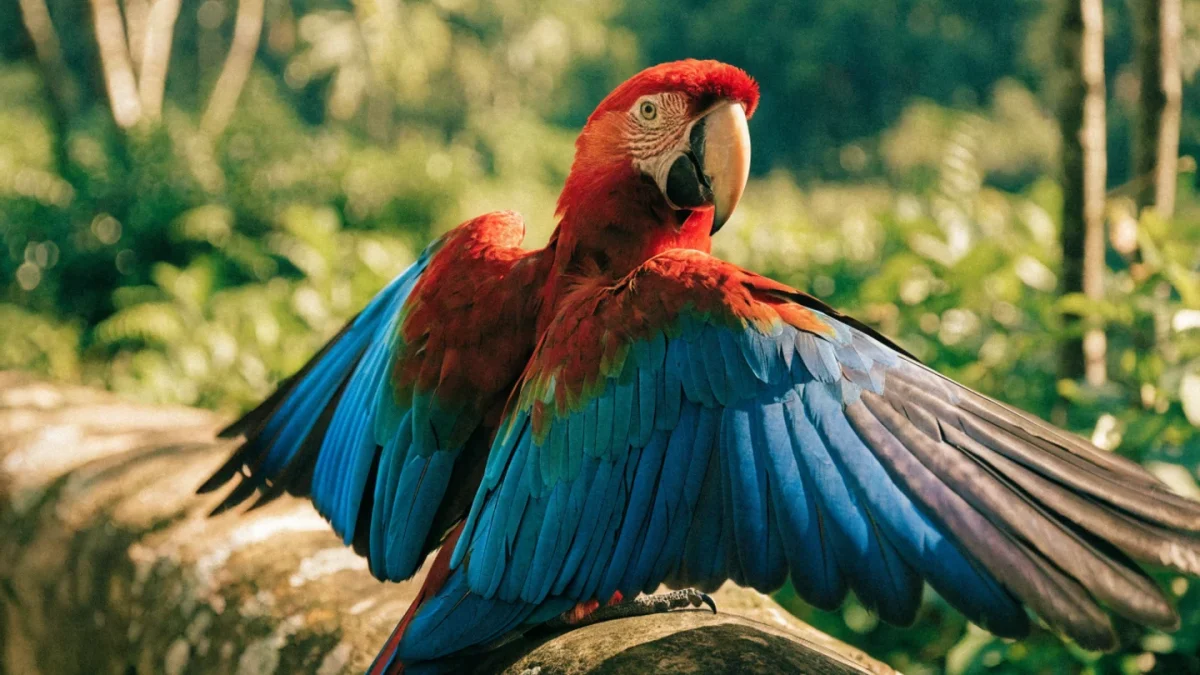
There's a moment with every macaw where you realize the bite force isn't theoretical. For me, it happened at a breeder's facility outside a small city — I was handling a three-year-old blue-and-gold who'd been sweet for twenty minutes, stepped up without hesitation, ate almonds from my fingers like we were old friends. Then someone dropped a metal food bowl in the next room. The macaw clamped down on my hand and I felt my knuckle compress in a way knuckles aren't supposed to compress.
No lasting damage. But I drove home with one hand and understood something I'd only read about before.
Macaws (Ara species, along with closely related genera like Anodorhynchus) need massive living spaces, a calorie-dense diet that includes significant nut and fresh food portions alongside pellets, and daily out-of-cage flight or exercise time. They produce contact calls exceeding 100 decibels. They live 50 to 70 years, sometimes longer. And they play rough — with their toys, their perches, their food, and occasionally your furniture, your doorframes, and your self-confidence.
Space: The Dealbreaker
I'm going to be direct. If you live in a small apartment, a macaw is not a reasonable choice.
The cage is the minimum requirement — a sleeping and feeding station that should be at least 120 cm wide, 90 cm deep, and 150 cm tall for a blue-and-gold or scarlet macaw. For a Greenwing or Hyacinth, go bigger or build a custom flight enclosure. A Hyacinth macaw (Anodorhynchus hyacinthinus) has a wingspan exceeding 100 cm. It cannot turn around comfortably in cages sold as "extra-large" at most pet supply retailers.
But the cage is where the bird sleeps and eats. The living space is your entire home — or at least one large, bird-proofed room where the macaw can fly, climb, and explore. I've visited keepers who converted spare bedrooms into bird rooms with ceiling-mounted perches, rope ladders, and foraging stations. Those birds were healthy, muscular, and behaviorally stable. The macaws I've seen living in cages with only brief handling sessions look different — duller plumage, weaker grip strength, and more fear-based biting.
Outdoor aviaries are ideal where climate allows. A flight aviary 3-4 meters long gives a macaw space to build real flight muscle. But outdoor housing requires predator-proofing, weather protection, and double-door entry systems to prevent escape.
Diet: More Fat, More Variety
Macaws are unusual among parrots in their relatively high fat requirements. In the wild, many macaw species eat palm nuts, Brazil nuts, and other calorie-dense foods that fuel their large bodies and high activity levels.
In captivity, the diet should be approximately 50-60% pellets, supplemented heavily with nuts and fresh foods. Macaws do well with almonds, walnuts, pecans, and macadamia nuts — but not as free-choice bowls. Ration them. A blue-and-gold gets maybe 8-12 almonds per day alongside its pellet and vegetable portions. Hyacinth macaws have specialized jaw structure for cracking extremely hard palm nuts, and their diets skew even higher in fat content — up to 50% of calories from nuts.
Fresh vegetables and fruits: same principles as other large parrots, but macaws tend to be less picky eaters than Greys. Mine ate nearly anything I offered, including vegetables that most parrots reject on sight. Peppers, corn on the cob, snap peas, cooked legumes, berries, mango, papaya. I used whole foods as enrichment — an entire pomegranate kept my scarlet macaw occupied for forty-five minutes.
The biggest dietary mistake I see with macaws is overfeeding sunflower seeds. Owners buy the big bags because macaws devour them. But sunflower seeds are essentially junk food — high in fat, low in calcium, and nutritionally incomplete. They're fine as occasional treats, not staples.
The Noise Reality
I cannot overstate this. Macaws are among the loudest animals you can legally keep in a home.
A blue-and-gold macaw's contact call registers around 105 decibels — louder than a running chainsaw, comparable to a rock concert. Scarlet macaws are slightly louder. Hyacinths, despite their enormous size, are actually somewhat quieter but still far above what anyone would call comfortable.
This sound happens at least twice daily — dawn and dusk — because contact calling is hardwired. You won't train it out of them. You can reduce duration by responding to the call (so the bird knows you're present and stops), and you can avoid reinforcing screaming at other times. But those morning and evening vocalizations? Non-negotiable.
I once helped a family rehome a blue-and-gold after their neighbors filed a noise complaint that escalated to their landlord. The family loved the bird. The bird was well cared for. But in a shared-wall townhouse, a macaw's voice carries through insulation like it isn't there. If you rent, check your lease. If you own, check your neighborhood tolerance. This isn't a concern you solve after purchase.
Temperament and Handling
Macaws are, broadly speaking, the extroverts of the large parrot world. Where an African Grey's more reserved temperament favors quiet observation and careful bonding, macaws tend to be bold, playful, and physically demonstrative. They want to be in the middle of things. They want to wrestle with toys, hang upside down, flap their wings at full extension, and occasionally test whether your ear is load-bearing.
That boldness extends to biting. Macaw beaks are powerful enough to crack Brazil nut shells and bend cage bars. A bite from an annoyed macaw can cause serious injury — lacerations, crushed fingertips, broken skin requiring medical attention. Reading body language is critical: pinning eyes (rapid pupil dilation/contraction), raised nape feathers, lunging posture, and tail fanning all signal agitation.
I used to volunteer at a rescue that had seventeen macaws. The best-adjusted ones were the birds that had consistent handling from multiple people, a regular training routine, and enough space to fly. The worst were the single-owner birds who'd been kept in too-small cages and only interacted with when convenient. The pattern was stark.
Species Differences Worth Knowing
Not all macaws are interchangeable. Blue-and-gold macaws (Ara ararauna) are often recommended as "beginner macaws" — they're adaptable, often good-natured, and more widely bred than other species. Scarlet macaws (Ara macao) tend to be more unpredictable temperamentally and are known for nippy phases. Greenwing macaws (Ara chloropterus) are the gentle giants — often calmer and more tolerant of handling than other species, but they're massive birds that need even more space. Hyacinth macaws are the largest parrots alive, incredibly gentle by reputation, and also incredibly expensive and specialized in their care needs.
Mini macaws — Hahn's, Severe, Yellow-collared — are sometimes overlooked but make more practical companions for people drawn to macaw personality without macaw size. They're still loud, still need space, but they fit into a wider range of living situations.
What Good Macaw Ownership Looks Like
The best macaw homes I've seen share a few features: a large dedicated space for the bird, an owner who treats training as a daily routine rather than an occasional activity, a household that accepts the noise as part of life rather than fighting it, and a financial cushion for avian veterinary care that routinely runs two to three times the cost of dog or cat visits.
And they all have one thing in common — the owner understood large parrot care requirements before the bird arrived, not after.
FAQ
Are macaws good for first-time bird owners?
Rarely. They're big, loud, expensive, bitey, and live longer than most marriages. If you've never kept a parrot, start with a smaller species — a conure, a cockatiel, even a budgie — and learn the rhythms of bird ownership first. People who jump straight to macaws without experience almost always underestimate something critical, and the bird pays for it.
How much does a macaw cost to keep per year?
Expect to spend between $1,500-3,000 USD annually on food, toys, veterinary care, and cage maintenance for a single macaw — and that's without emergencies. Avian vet visits alone can run $200-500 per checkup. Emergency surgery for a crop burn or fractured beak will cost significantly more.
Can macaws be kept outdoors?
In warm climates, yes — with a proper aviary. Macaws tolerate heat well but need shade and fresh water. They cannot tolerate prolonged cold below about 10°C (50°F). The aviary must be fully enclosed, predator-proofed, and have a sheltered area for rain and wind. Double-door entry is mandatory to prevent flyaways.
Do macaws get along with other pets?
Not safely. A macaw's beak can severely injure a dog or cat, and a dog or cat can injure or kill a macaw. Supervision isn't enough — I've heard too many stories of incidents happening in seconds. Keep them separated. Some macaws coexist with other parrots, but introductions must be gradual and cages always separate.