

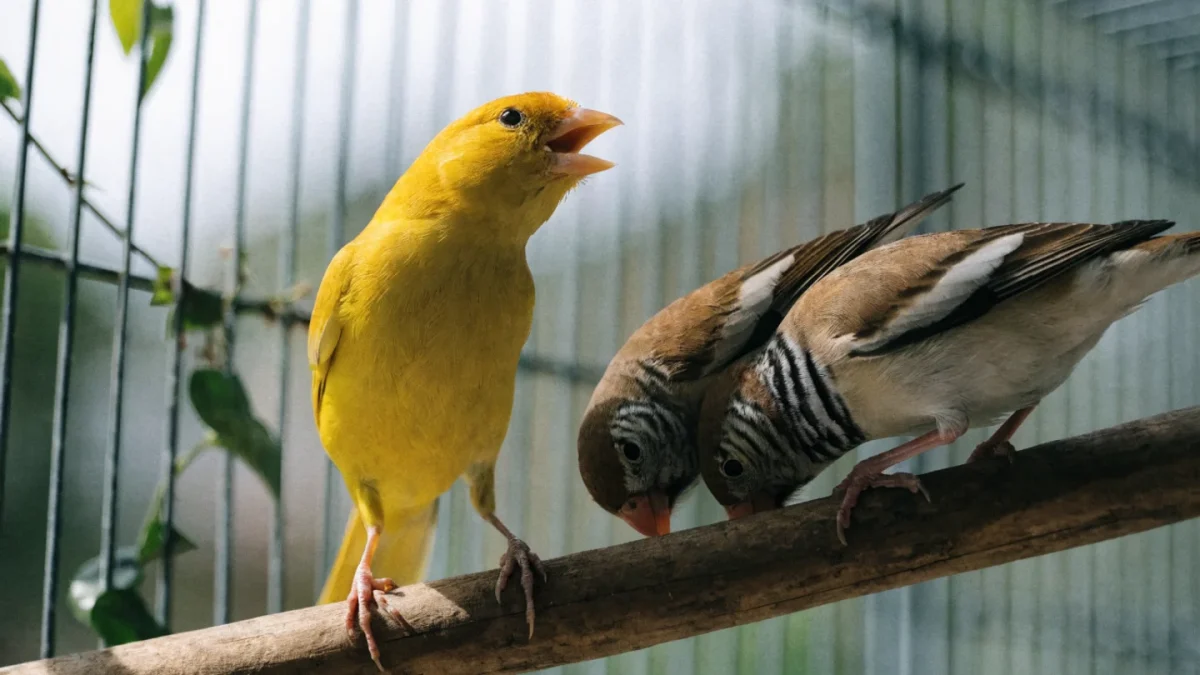
The first canary I ever kept sang exactly once on the car ride home — a single rolling phrase that filled the entire vehicle — and then didn't make another sound for three weeks. I was nineteen, had just picked him up at a bird show from a breeder who kept maybe two hundred canaries in an outdoor flight, and I was convinced something was wrong. Nothing was wrong. He was adjusting. When the song finally came back, it came back at five in the morning and didn't stop until dusk.
Canaries and finches are the most commonly kept cage birds worldwide, and they share enough biology that people lump them together — but the differences in temperament, social needs, and husbandry are significant enough that buying the wrong species for your situation leads to frustration fast. Canaries (Serinus canaria domesticus) are primarily kept for their song, prefer solitude or carefully managed pairs, and bond loosely with their keepers. Finches — a broad category that includes zebra finches, Gouldian finches, society finches, and dozens of others — are social flock birds that need companions of their own kind and produce cheerful chirps rather than complex melodies.
Choosing Between Canaries and Finches
This decision shapes everything else. It determines cage size, how many birds you'll keep, noise levels, and how much interaction you'll have with your birds.
Canaries are soloists. A single male canary in a properly sized cage will sing throughout the day and can become surprisingly responsive to your presence — flying to the side of the cage when you enter the room, eating from a dish you're holding. They're not cuddly. They're not parrots. But they develop real recognition of their keeper, and the song is genuinely remarkable once you've lived with it.
Finches are ensemble players. A single finch is a stressed finch. They need at least one companion, and most species do best in groups of four to six. The trade-off: they're less individually interactive with humans, but watching a small flock of finches go about their day — bathing, squabbling over perches, nest-building — is endlessly entertaining in a way that a single bird can't replicate.
If you want song, get a male canary. If you want activity and social dynamics, get finches. If you want both, you can potentially house them together — but only in a large flight cage, and only with compatible species. More on that below.
Species Worth Knowing
I'm not going to list every finch species available in the trade. Instead, here are the ones you'll actually encounter and the ones worth considering.
Canaries
Domestic canaries come in three broad categories: song breeds (bred for vocal quality), color breeds (bred for plumage), and type breeds (bred for body shape and posture). For most keepers, the distinction that matters is song. Song-bred males — particularly roller canaries and waterslager canaries — produce complex, multi-phrase songs with remarkable range. Color-bred males sing too, but the song may be less developed.
Females don't sing in the way males do. They chirp, they call, but the sustained rolling song is a male trait driven by testosterone. If song is your primary motivation, you need a male, and you need to hear him sing before purchase if possible.
Zebra Finches
The starter finch. Hardy, inexpensive, breed readily (sometimes too readily), and available everywhere. They're noisy in groups — a constant background chatter of beeps and buzzes that some people find charming and others find maddening. I've kept zebra finches on and off for over a decade and I still find their social dynamics fascinating. They pair-bond strongly and will nest in almost anything you provide.
Gouldian Finches
Stunning. Absolutely stunning — the kind of bird that makes people stop and stare. Red, black, or orange heads. Purple chests. Green backs. They look hand-painted. But Gouldians are more demanding than zebra finches. They need consistent warmth (they come from tropical northern Australia), are prone to air-sac mite infections, and don't tolerate environmental stress well. I'd call them intermediate, not beginner.
Society Finches
Society finches (Lonchura striata domestica) don't exist in the wild — they're a fully domesticated species, likely derived from the white-rumped munia. They're extraordinarily docile, breed prolifically, and are famously used as foster parents for more delicate finch species whose own parenting instincts are unreliable. If you want the easiest possible finch experience, societies are hard to beat.
Cage Setup
The single biggest mistake in canary and finch keeping is cage size. These birds fly horizontally. A tall, narrow cage is nearly useless to them. Length is what matters.
For a single canary or a pair of finches: minimum 75 cm (30 inches) long. For a small finch flock of four to six birds: minimum 90-120 cm (36-48 inches) long. A proper flight cage gives them room to actually fly short distances between perches rather than just hopping.
Bar spacing matters more than people realize. Finches are tiny — zebra finches weigh about 12 grams. Bar spacing should be no wider than 1 cm (roughly 3/8 inch). I've seen finches squeeze through 1.3 cm spacing. Canaries can handle slightly wider spacing, up to about 1.3 cm, but erring on the smaller side doesn't hurt.
Perch Placement
Place perches at different heights and at opposite ends of the cage so birds fly between them rather than just hopping laterally. Use natural wood perches of varying diameters — this exercises the feet and prevents pressure sores. Dowel perches of uniform diameter contribute to bumblefoot over time.
Avoid placing perches directly above food or water dishes. The math on this one is simple and unpleasant.
Bathing
Canaries and finches love to bathe. Provide a shallow dish of room-temperature water daily or at least several times a week. The dish should be shallow enough that the bird can stand in it — about 2-3 cm deep. Some birds prefer to bathe in a clip-on bath that attaches to the cage door, which keeps the cage floor drier.
Watching a canary bathe is one of the small pleasures of keeping them. They dunk, shake, flutter, and repeat with a dedication that borders on obsessive. Remove the bath dish after an hour or so to prevent the water from fouling.
Diet
A seed-only diet will keep canaries and finches alive. It won't keep them healthy long-term.
Seed Mix
A quality seed mix forms the base — for canaries, look for a canary-specific mix (higher proportion of canary grass seed and rapeseed). For finches, a finch mix with millet varieties, canary seed, and niger seed. Avoid mixes with large sunflower seeds or peanut pieces, which are too large and too fatty for these species.
Beyond Seeds
Egg food — a crumbly mixture of hard-boiled egg, breadcrumbs, and sometimes grated carrot — provides protein that seeds alone lack. It's especially critical during breeding season and molt. You can make it at home or buy commercial egg food mixes. I make my own by mashing a hard-boiled egg (shell included for calcium) with fine breadcrumbs until it's the texture of coarse sand.
Fresh greens daily: dandelion leaves, romaine lettuce, broccoli florets, grated carrot, spinach in small amounts. Some keepers offer sprouted seeds, which are nutritionally superior to dry seeds — the sprouting process increases vitamin content and reduces fat. Sprouting takes minimal effort: soak seeds overnight, rinse, let sit in a strainer for 24-48 hours, rinse again. Offer when the tails are just showing.
Cuttlebone or mineral block for calcium — keep one in the cage at all times. Grit is debated; canaries and finches hull their seeds before swallowing, so they don't strictly need grit for digestion the way pigeons or chickens do. I offer a small dish of mineralized grit anyway. The birds pick at it occasionally and it doesn't hurt.
If you're coming from parrot or budgie care, the dietary approach feels simpler — and it is, mostly. But the simplicity makes it easy to get lazy and just top off the seed dish indefinitely. Don't. Fresh food matters.
Temperature and Environment
Canaries and finches do well at normal household temperatures — 18-24°C (65-75°F). They tolerate cooler temperatures better than most people expect (canaries are historically European cage birds and have been kept in unheated rooms for centuries), but sudden temperature swings stress them.
Draft is the enemy. A cage near a window that gets direct afternoon sun can overheat. A cage in the path of an air conditioning vent creates dangerous cold drafts. Position the cage against a wall (gives the birds a sense of security), at chest height or higher (birds feel vulnerable below eye level), and away from the kitchen (cooking fumes, non-stick cookware fumes, and temperature fluctuations are all hazards).
Non-stick cookware deserves its own sentence. The fumes from overheated PTFE-coated pans can kill a canary or finch fast — veterinary sources describe sudden death occurring before or shortly after any symptoms show, and smaller birds are consistently flagged as the most sensitive of all. If you keep birds, eliminate non-stick from your kitchen or guarantee absolute ventilation separation.
Lighting
Canaries and finches need a consistent light-dark cycle. Roughly 12 hours of light and 12 hours of dark works year-round, though adjusting seasonally (14 light / 10 dark in summer, 10 light / 14 dark in winter) more closely mimics natural conditions and supports healthy molt cycles. Cover the cage or move it to a dark room at night — ambient light from screens and lamps disrupts sleep.
Full-spectrum lighting can supplement natural light, especially in rooms without much window exposure. It's not as critical as UVB is for reptiles, but it supports feather condition and natural behavior.
Song and Vocalization
Male canaries sing. That's the headline. The song is hormonally driven, peaks during breeding season (roughly spring through early summer), and can diminish or stop entirely during the annual molt when testosterone drops. A canary that stops singing during molt isn't sick — he's putting energy into feather replacement.
Song quality varies enormously between individuals and between song breeds. A trained roller canary produces low, rolling passages with the beak nearly closed. A waterslager sings louder, more varied phrases. A color-bred canary may have a pleasant but simpler song.
Young males learn song elements from adult males they hear during their first few months of life. If you acquire a young bird, what he hears matters. Some breeders train their birds using recordings of champion singers — the avicultural equivalent of playing classical music for your kids, except it actually works with canaries.
Finches don't sing in the canary sense. Zebra finches produce a buzzy, rhythmic vocalization that males repeat in structured phrases. Gouldian finches are relatively quiet. Society finches make soft warbling sounds. None of them fill a room the way a canary does.
Mixing Canaries and Finches
Possible, with caveats. A large flight cage — 120 cm minimum — can house a male canary alongside a group of zebra finches or society finches. The canary will mostly ignore the finches. The finches will mostly ignore the canary.
Problems arise during breeding season when the canary's territorial instincts ramp up. A male canary defending a perceived territory in a shared flight can harass finches — chasing them off perches, interrupting their feeding. In a small cage, there's nowhere for the finches to retreat. In a large flight with multiple feeding stations and perching areas, conflicts are usually manageable.
Don't mix canaries with Gouldian finches. Gouldians are more delicate and can carry air-sac mites without showing symptoms — but canaries are highly susceptible to the same mite and can die from infections that Gouldians barely notice.
And never mix canaries with other canary-family species. Canaries can hybridize with several wild finch species, and hybrids create welfare and conservation issues.
Molt
Every canary and finch goes through an annual molt, replacing all feathers over a period of six to eight weeks. During molt:
- Singing stops or decreases dramatically (canaries)
- Birds look ragged, may have patchy plumage
- Energy requirements increase
- Stress tolerance drops
Support molt with increased protein (more egg food), consistent temperatures, and reduced handling or environmental changes. This isn't the time to rearrange the cage, introduce new birds, or move the cage to a new room. I learned this the hard way when I rearranged an entire bird room mid-molt and had a canary go into a stress molt on top of his regular molt. He looked like he'd been through a wind tunnel.
Health Basics
Find an avian vet before you need one. Most general-practice veterinarians have limited experience with passerines — you want someone who regularly treats small birds.
The three most common issues I've dealt with:
Air-sac mites (Sternostoma tracheacolum) cause labored breathing, tail-bobbing, clicking sounds during respiration, and loss of song. They're treatable with ivermectin but can be fatal if left unchecked. This is the number-one health concern in canaries and Gouldian finches.
Scaly face and leg mites cause crusty, rough growths on the beak, legs, and feet. Treatable with ivermectin or a mite-specific product applied to the affected areas. Highly contagious between birds.
Egg binding — a female unable to pass a fully formed egg — is an emergency. Signs include straining on the cage floor, fluffed feathers, and lethargy. Provide warmth and humidity immediately and get to a vet. Calcium deficiency and poor diet are the primary contributors.
Healthy canaries and finches are active during the day, eat regularly, have clean vent feathers, clear eyes, and smooth plumage (outside of molt). A bird sitting fluffed on the cage floor with eyes half-closed is sick and needs a vet now, not tomorrow.
Frequently Asked Questions
Can I keep a single canary, or does it need a companion?
A single male canary does perfectly well on its own — and in fact, a lone male in his own cage will usually sing more than one housed with another canary. Males in visual or auditory contact with other males may compete vocally, which can be a bonus if you enjoy the song. Females can be kept alone too, but they don't sing, so the appeal is different. The loneliness concern that applies to finches doesn't apply the same way to canaries. They're more solitary by nature.
Do canaries and finches need to come out of the cage?
Not in the way a parrot does. Canaries and finches aren't handling birds — they don't perch on your finger and hang out on your shoulder. Free-flight time in a bird-safe room can be enriching, but it's risky. These are small, fast birds that can fly into windows, mirrors, ceiling fans, or behind furniture. If you do offer out-of-cage time, close all windows and doors, cover mirrors, and turn off fans. Personally, I provide large enough cages that the birds get adequate exercise without free-flight risk.
How noisy are finches compared to canaries?
Different kind of noise. A male canary sings loudly and melodically — you'll hear it clearly from two rooms away, and during peak season it's nearly continuous during daylight. Finches produce a constant low-level chatter: beeps, chirps, buzzes. It's lower volume per bird but it's persistent. A group of six zebra finches creates a steady background soundtrack that some people genuinely love and others find irritating. Neither is as loud as a cockatiel or any parrot species.
How often should I clean the cage?
I change cage paper and clean water dishes daily. Food dishes get emptied of husks and refilled daily — blow on the seed dish before deciding it's full, because the husks sit on top and make it look like there's more food than there actually is. A thorough cage clean — washing bars, replacing perches if soiled, scrubbing the bath dish — happens weekly. Full disinfection monthly unless you're managing a health issue, in which case more frequently.
Can I breed canaries and finches at home?
You can, and both will breed readily in captivity if conditions are right. Zebra finches in particular breed so willingly that the bigger challenge is preventing unwanted breeding. Canary breeding is more structured — pairing a good singer with a healthy hen, providing a nest cup and nesting material, and pulling the cock bird once chicks are being fed. But breeding means chicks, and chicks mean you need to either keep more birds or find homes for them. Don't start breeding until you've kept the adult birds successfully for at least a year.
A seed dish, a bath, a decent cage, and some patience. That's the baseline. But the gap between baseline keeping and keeping that actually lets these birds thrive — full song from a canary, a busy flock of finches building nests and chasing each other around a flight cage — comes down to the details above. Get the cage length right. Feed more than just seeds. Watch for the early signs of illness. And accept that you're going to find feathers in places you never expected.