

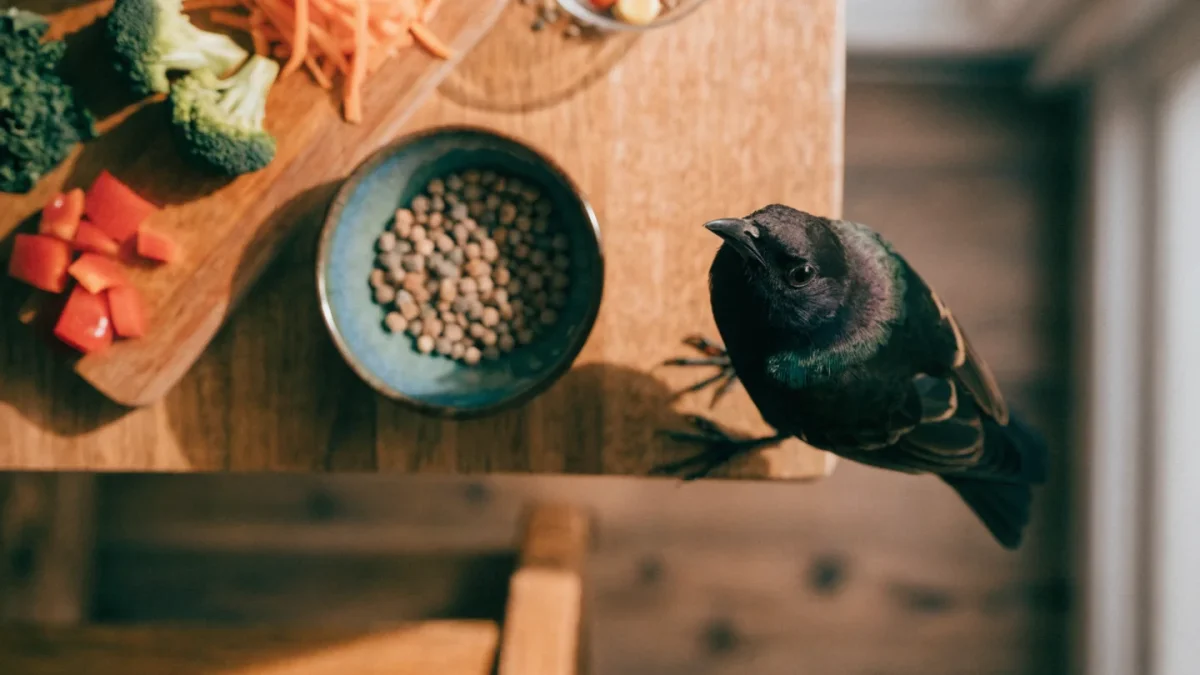
Every online forum about budgies eventually produces the same argument: seeds versus pellets. Somebody posts a photo of their budgie's seed bowl, somebody else calls it a death sentence, and then forty people pile in with strong opinions and not enough evidence.
A budgie's diet shapes its feather quality, energy level, immune function, and lifespan more directly than almost any other care factor. The right food won't guarantee a long life, but the wrong food almost guarantees a short one. Wild budgerigars in the Australian grasslands eat a varied diet of native grass seeds, greens, and occasionally insects — a menu that looks nothing like a bag of commercial seed mix heavy on sunflower and millet.
Pellets as the Foundation
Pellets should make up roughly 60-70% of what your budgie eats daily. They're formulated to deliver consistent nutrition in every bite — unlike seeds, where a budgie can pick out the fattiest ones and leave the rest.
The transition from seeds to pellets is notoriously difficult. I've worked with keepers who spent six weeks mixing pellets into seed, gradually increasing the ratio, and their budgie still flicked every pellet out of the bowl. It's frustrating. But it works eventually if you stick with it.
Some strategies that help:
Crush pellets into a fine crumble and mix with familiar seed. The budgie accidentally eats pellet dust while digging for seeds. Gradually increase pellet size as they acclimate.
Try the "morning pellets" approach — offer pellets first thing when the bird is hungriest. Remove them after a few hours and offer seed-pellet mix for the rest of the day. Over weeks, the bird learns that pellets are food.
Wet pellets into a warm mash. Some budgies that refuse dry pellets will try them moist. Others ignore the mash entirely. Every bird is different.
I had a rescue budgie two years ago — five years old, had eaten nothing but seed his entire life. It took eight weeks of patient mixing before he reliably ate pellets. His feathers improved noticeably within three months.
Fresh Vegetables: Daily and Non-Negotiable
Vegetables should form 20-30% of your budgie's daily diet. The budgie care basics cover this broadly, but here's what actually works.
High-value options: Dark leafy greens (kale, Swiss chard, dandelion greens), broccoli florets, shredded carrot, snap peas, bell pepper slices (all colors), cooked sweet potato in small amounts.
Worth trying: Zucchini, cucumber (low nutritional value but high hydration), corn on the cob (fresh, not canned), green beans, sprouts. Sprouts are nutritional powerhouses — sprouted lentils, mung beans, and quinoa offer enzymes and nutrients that dry seeds lack.
How to get a stubborn budgie to eat vegetables: Clip leafy greens to the cage bars so they look like foraging material, not something strange in the food bowl. Chop veggies very finely and sprinkle over pellets. Eat vegetables yourself in front of the cage — budgies are social eaters and flock instinct drives curiosity. It sounds silly. It works more often than it should.
Remove uneaten fresh food after three to four hours. Bacteria multiply fast at room temperature, and wilted greens in the cage are a health risk, not a snack.
Seeds: Treats, Not Meals
Seeds aren't evil. They're just incomplete.
A typical commercial seed mix for budgies contains millet, canary grass seed, oats, and often sunflower seeds. Budgies love sunflower seeds the way children love candy — they'll eat them exclusively if given the chance. But sunflower seeds are roughly 50% fat by weight. A budgie on a high-sunflower diet develops fatty liver disease, obesity, and frequently dies years before it should.
Use seeds as training rewards, foraging incentives, or a small evening snack. A teaspoon of mixed seed per day per budgie is a reasonable limit once they're eating pellets well.
Millet spray is the single most effective training treat. Every budgie I've worked with — tame, untame, rescue, breeder-raised — responds to millet. Hang a spray in the cage sparingly (a few times per week), or hold it during taming sessions.
Fruits: Occasional and Small
Fruits are fine in moderation. A slice of apple, a few blueberries, a chunk of melon — once or twice a week.
The sugar content is the concern. Wild budgies don't encounter cultivated fruit, and their metabolism isn't built for daily doses of fructose. I keep fruit treats to roughly 5% of total intake.
Safe fruits: Apple (remove seeds — they contain trace cyanide compounds), blueberries, strawberries, banana, grapes, watermelon, mango, papaya, kiwi.
Avoid: Avocado is toxic to birds. Full stop. Also skip anything with pits that the bird could access — cherry and peach pits contain cyanogenic compounds.
What's Toxic — The Short List
Some foods are deadly in small amounts:
Avocado. Chocolate. Caffeine (coffee, tea, energy drinks). Onion and garlic. Alcohol. Rhubarb leaves. Uncooked dried beans. Fruit pits and apple seeds in quantity.
If your budgie eats something you're unsure about, contact an avian vet immediately. Don't wait for symptoms. Small bodies mean small margins.
Water, Supplements, and Extras
Fresh water daily — obvious, but worth emphasizing because dirty water is a primary vector for bacterial and fungal infections. If you're using an open bowl (I prefer these over bottles because you can spot contamination instantly — see the advice on cage food bowl placement), change it whenever you see debris floating.
A cuttlebone provides calcium and beak conditioning. Mineral blocks are fine but less engaging for most birds.
Vitamin supplements in the water are generally unnecessary if the bird eats pellets and vegetables. Over-supplementation — particularly vitamin A and D — can cause toxicity. If your vet recommends a specific supplement for a deficiency, follow their dosing. Otherwise, a balanced diet does the work. For a broader look at how nutrition requirements differ across birds, reptiles, and small mammals, the exotic pet nutrition guide breaks it down species by species.
FAQ
How much should a budgie eat per day?
A healthy budgie eats roughly 1.5 to 2 teaspoons of pellets daily plus a generous offering of fresh vegetables. They're grazers by nature and eat small amounts throughout the day rather than sitting down for big meals. If your budgie empties its bowl rapidly and begs for more, the portion is probably too small — or they're selectively eating only the parts they like.
My budgie only eats seed and refuses everything else. What do I do?
Keep offering. Seriously, that's the primary answer. Place pellets and vegetables in the cage daily even if they go untouched. Try different presentations — clipped greens, chopped fine, mixed in, offered from your hand. Some birds take months. I know that's not what anyone wants to hear, but slow persistence beats starvation forcing, which can kill a small bird in 24-48 hours.
Are sprouted seeds better than dry seeds?
Significantly. Sprouting converts stored fats into proteins and releases enzymes and vitamins. The nutritional profile of a sprouted mung bean or lentil is dramatically better than a dry seed. They're also softer and more interesting for budgies. Rinse sprouts thoroughly and offer them fresh — they mold fast.
Can budgies eat people food like bread, pasta, or rice?
Small amounts of cooked whole-grain rice or pasta won't harm a budgie, but they're nutritionally empty calories. Bread is even less useful. These shouldn't be regular offerings. If your budgie steals a bite of your dinner, the real concern is salt and seasoning — even a small amount of salt is dangerous for a bird this size.