

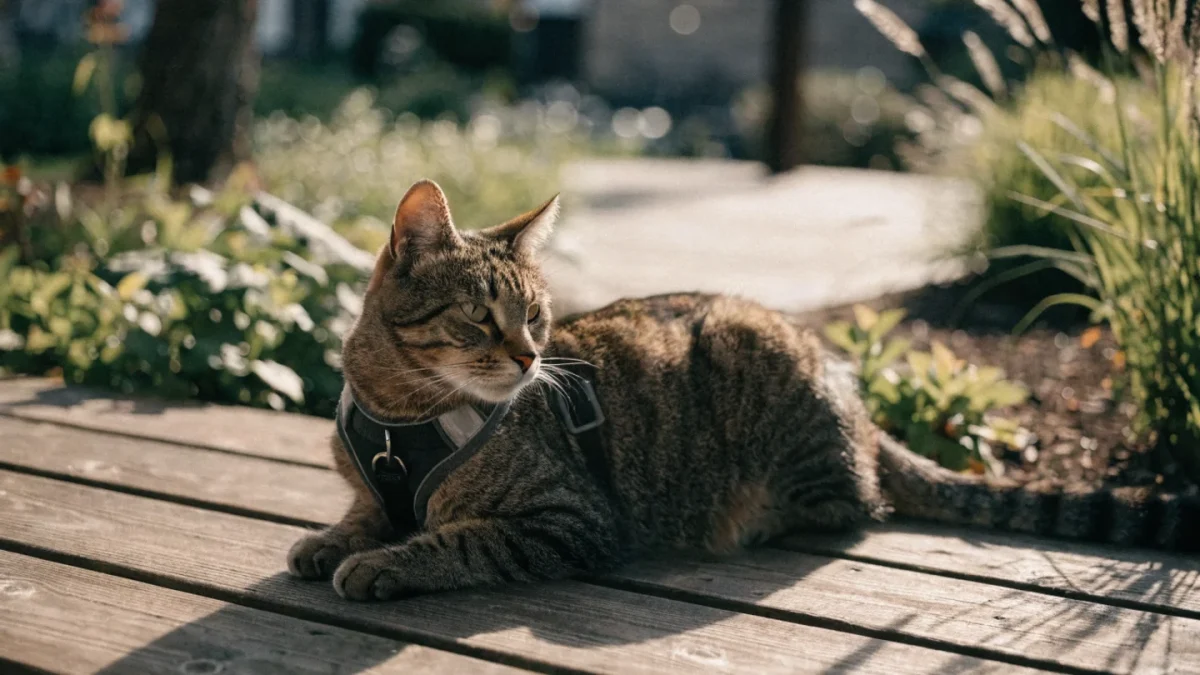
Here's what's actually going on when your cat freezes the moment you clip a leash to them and stare at you like you've personally betrayed them: they have no idea what's happening, and that's entirely fair. Leash walking a cat is absolutely doable — my cat Miso proved that to me when she went from bolting under the bed at the sight of a harness to trotting down the sidewalk like she owned it — but it requires a different approach than walking a dog. A much slower one. Stepping back, indoor vs outdoor cats gives you the context that makes this click.
The good news is that the process itself isn't complicated. It's just patient.
Why Harness Training Comes First
Before any actual walking happens, your cat needs to accept the harness as a normal, non-threatening part of their world. Cats don't generalize the way dogs do. Wearing something unfamiliar on their body is genuinely alarming to them at first — it triggers that freeze response, the flopping to the ground, the dramatic inability to move their legs.
This isn't stubbornness. This is a cat telling you they need more time.
Skip the harness conditioning phase and you'll end up with a cat who associates the leash with stress, which makes every future session harder. Spend the time now and the rest goes smoothly.
The harness itself matters too. Look for an H-style or figure-eight harness specifically designed for cats — not a dog harness scaled down. It should sit snugly enough that you can fit two fingers underneath the straps but no more. A harness that's too loose is a genuine escape risk, and cats are disturbingly good at slipping out of things they've decided they don't want to be in.
Step 1: Introduce the Harness Without Putting It On
Leave the harness near your cat's food bowl or favorite nap spot for a few days. Let them sniff it, rub their face on it, ignore it completely. You're just establishing that this object exists and isn't a threat.
When your cat seems comfortable around it — or at minimum indifferent — you can move to the next step.
Step 2: Drape It, Don't Clip It
Hold the harness open and let your cat walk through it or put it loosely over their back without fastening anything. Pair this with treats. High-value ones — whatever makes your cat actually interested, not just tolerant. how to transition an outdoor cat gets into this from another angle.
Do this for short sessions, a few minutes at a time, over several days. The goal is a cat who will walk toward you when they see the harness coming out. Miso took about a week to get here. Some cats take three days. Some take three weeks. Both are normal.
Step 3: Fasten the Harness Indoors
Once your cat is comfortable having the harness draped on them, start fastening the clips. Keep the first few sessions very short — clip it on, give treats, take it off. Don't make a big deal out of it. Low energy from you signals low stakes to them.
Let your cat wear the harness around the house for gradually longer stretches. Watch for signs of discomfort: freezing completely, trying to back out of it, excessive grooming of the straps. If you see those, slow down. If your cat takes a treat and then walks off to investigate something, you're in good shape.
Step 4: Add the Leash Indoors
Clip the leash to the harness and let it drag on the floor while your cat walks around inside. Some cats don't care at all. Others are deeply suspicious of this rope following them everywhere. Either way, let them get used to the weight and sensation before you pick up the other end.
Then pick up the other end — but don't guide or pull. Just follow your cat around the house holding the leash loosely. You're teaching them that leash tension doesn't mean danger.
Honestly, this indoor leash phase is where most people rush, and it's the step that matters most. A cat who's practiced on a leash inside will be far more adaptable outside.
Step 5: The First Time Outside
The real question people ask at this point is: where do I start? The answer is: your doorstep. Literally just outside your front door or on a patio or balcony. There's more to say about cat training — I gave it its own piece.
Carry your cat outside rather than walking them through the door on leash — the threshold itself can be stressful. Set them down in a calm spot, keep the leash loose, and let them take in the environment. Don't try to walk anywhere the first few times. Just let them look around, sniff the air, and decide when they're ready to move.
Your cat is going to be overstimulated by smells, sounds, and visuals that don't exist inside. Some cats freeze. Some crouch low and observe everything very carefully. Some immediately try to go back inside. All of these are fine. The goal for the first session is simply: outside happened and nothing bad occurred.
Step 6: Building Up From There
Once your cat is reliably calm on your porch or just outside your door, start taking a few steps. Let them lead. If they want to sit and watch a bird for ten minutes, that's a successful walk. Leash walking a cat is less about covering distance and more about giving them controlled access to an environment they don't normally have.
Keep early outdoor sessions short — five to ten minutes is plenty. End on a calm note before your cat gets stressed, not after. Over time, most cats will start to pull toward the door when they want to go out, which is a good sign they're associating the harness with something enjoyable.
A Few Things That Trip People Up
Don't force movement. If your cat sits down and refuses to budge, crouch down with them or wait. Dragging or coaxing creates negative associations fast.
Watch for stress signals. Flattened ears, wide pupils, low crouching, tail tucked — these mean your cat is done. Pick them up and go back inside. A short positive session beats a long stressful one every time.
Pick quiet times and places. Early mornings when there's less foot traffic, fewer dogs, and less noise. Loud and busy environments are overwhelming for a cat just learning to be outside.
Be realistic about weather and surfaces. Hot pavement, wet ground, and heavy wind are all reasons a cat might flatly refuse to cooperate with your plan. Can't blame them.
Frequently Asked Questions
How long does it take to leash train a cat?
Most cats need two to four weeks of consistent daily practice to go from "harness? absolutely not" to comfortable outdoor walks. Some adapt faster, some slower. Age plays a role — younger cats tend to acclimate more quickly — but adult cats can absolutely learn this. It just takes patience.
Can all cats learn to walk on a leash?
Most cats can be leash trained to some degree, but not every cat will enjoy it. High-anxiety cats, cats with certain health issues, or cats who find the outdoors genuinely frightening may never get past the doorstep phase — and that's okay. Leash walking should be enriching, not stressful. If your cat is consistently distressed despite slow, careful training, it may not be the right activity for them.
Do I need a specific type of harness?
Yes. Use a harness made specifically for cats — H-style or figure-eight designs offer the best security. Avoid collar-only setups; cats can slip collars, and leash pressure on a collar puts strain on the neck. A well-fitted cat harness distributes pressure across the chest instead.
What if my cat just lies down and won't move?
Completely normal, especially in the first few outdoor sessions. Don't pull or coax. Give them a moment, then try crouching next to them and offering a treat in the direction you want to go. If they're just flopped dramatically in the grass looking miserable, they're probably done for the day. Pick them up, go inside, try again tomorrow with a shorter session.