

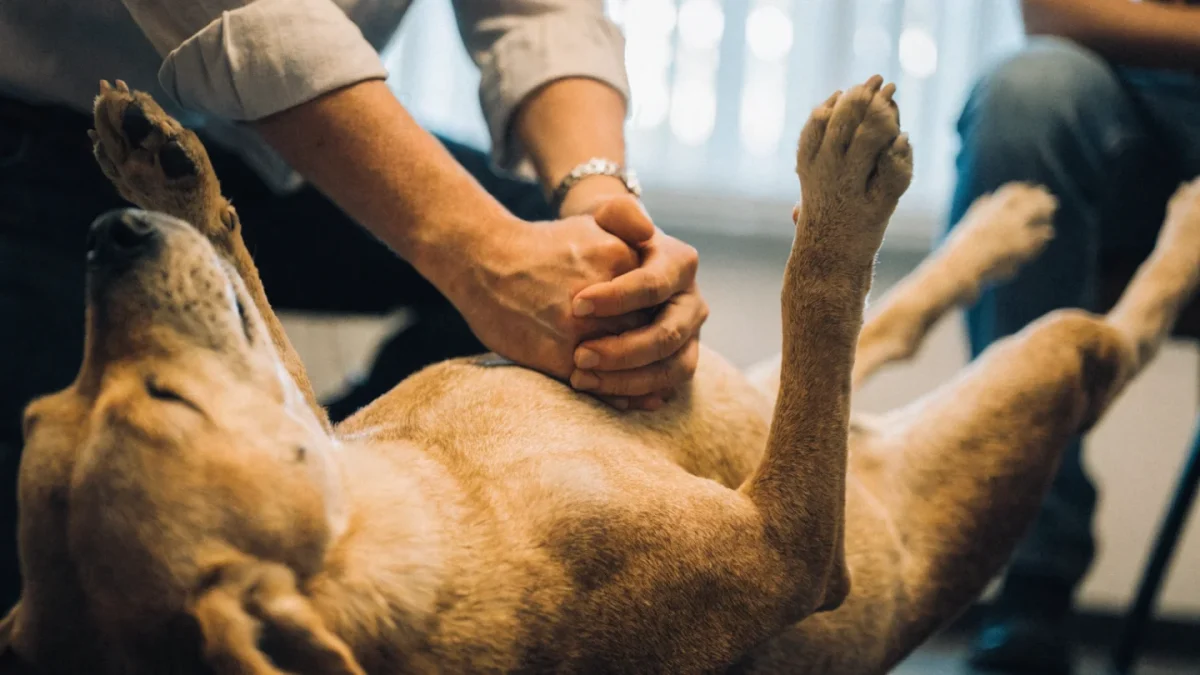
I've done CPR on dogs in my clinic more times than I'd like to count. Most of those patients didn't make it — not because the technique failed, but because the underlying cause was too severe or too far advanced. I'm telling you this not to discourage you but to set honest expectations. CPR buys time. In some cases it's the difference between death before reaching the clinic and arriving with a chance. That chance matters enormously.
What you need to understand first: CPR is only indicated when your pet has no heartbeat and is not breathing. Not when they're unconscious. Not when they're weak or disoriented. Chest compressions on a beating heart can actually cause arrhythmias. So before you start — check.
Step One: Verify the Need for CPR
Lay your pet on a firm surface. Look for chest movement. Feel for breath from the nose or mouth — hold the back of your hand near the muzzle. For the heartbeat: place your hand just behind the left elbow, on the chest wall. You should feel a distinct pulse. If you want to feel the femoral pulse instead, press your fingers into the groove where the inner thigh meets the abdomen.
If there's no breathing and no pulse: start CPR immediately and have someone else call the emergency clinic.
If there's no breathing but a pulse is present: rescue breathing only. No compressions.
If there's a pulse but labored breathing: don't do CPR — support their airway and get to the vet.
Positioning
Right side down, on a flat firm surface. The floor is better than a sofa or a car seat — you need to push down against something solid.
For cats and small dogs (under 30 lbs): cup both hands around the chest, or place your thumb and fingers on either side of the chest just behind the elbows.
For medium to large dogs: place the heel of one hand over the widest part of the chest — roughly behind the shoulder blades — and place your second hand on top.
For barrel-chested breeds (Bulldogs, Basset Hounds) and flat-chested breeds (Greyhounds, some Mastiffs): position may need adjustment. Barrel-chested dogs may actually be easier to do dorsal recumbency (on the back) with compressions directly over the sternum. This is unusual enough that most people won't need to think about it, but worth knowing.
Rescue Breathing First
Two initial rescue breaths before compressions begin.
Hold the mouth closed with one hand. Place your mouth over the entire nose (not just a nostril). Breathe in steadily — you're aiming for a breath that takes about one second, and you should see the chest visibly rise. If the chest doesn't rise, recheck that the mouth is closed and the airway isn't blocked.
For cats and small dogs: a very gentle puff — their lung capacity is much smaller than yours. I've seen people over-inflate small animals during CPR. If you're delivering a breath that would fill a balloon, it's too much for a cat.
Chest Compressions
30 compressions, then 2 breaths. Repeat.
Rate: 100-120 compressions per minute. Think of the rhythm of "Stayin' Alive" by the Bee Gees — genuinely not a joke, it's the correct cadence and it's easier to maintain than counting.
Depth: For large dogs, compress 1 to 1.5 inches (about one-third of the chest width). For cats and small dogs, 0.5 to 1 inch.
Arms straight. Use your body weight to drive the compressions, not just your arm muscles. Lock your elbows and push from your shoulders. This is tiring — if you have someone with you, switch every two minutes.
Allow the chest to fully recoil between compressions. This is important and easy to shortchange when you're panicking. The recoil is what draws blood back into the heart; without it, you're just pushing without the necessary suction on the intake.
For Cats Specifically
Cats are small and surprisingly fragile during CPR. Two options for compression technique:
Circumferential method (preferred for small cats): Both hands wrap around the chest with thumbs meeting at the sternum. Squeeze rhythmically. This mimics how we do infant CPR and tends to be gentler.
Two-finger sternal method: Index and middle finger placed over the sternum, between the shoulder blades. Press down about a half inch. Good for very small cats or kittens.
Rescue breathing for cats: your mouth should cover the entire nose. Tiny breath. Watch for chest rise. If you cover the nose and mouth together (like CPR on a small child), be careful not to push too much air.
While You're Doing CPR
Get to the vet. CPR without access to defibrillation, IV medications, and oxygen supplementation has a success rate that varies enormously based on the underlying cause, including build first. You cannot defibrillate at home. The goal of CPR is to preserve organ perfusion until you reach professional care.
If you're alone: you have to make a decision. In a genuine cardiac arrest, driving is probably the right call even without continuous CPR en route — stopping every few minutes to do a few cycles while in a safe parking spot may be your only option.
If two people are with the pet: one does CPR, one drives.
Call ahead. The words "my pet is not breathing and has no heartbeat, I'm performing CPR, I'm five minutes away" will have the team at the door with equipment ready.
What to Do If the Heart Restarts
Stop compressions but continue monitoring breathing. Recovery of heartbeat doesn't always mean immediate recovery of consciousness or normal breathing. Keep the airway open, keep them warm, and don't stop driving to the clinic — they still need immediate professional care.
A pet that restarts after cardiac arrest has a serious underlying event. They need an EKG, oxygen, bloodwork, and likely hospitalization.
CPR on Neonatal Puppies and Kittens
Very different situation. Neonates are tiny and extremely fragile. For a puppy or kitten that isn't breathing after birth:
- Rub briskly with a warm towel — this stimulates breathing and removes birth membranes.
- Gently clear the airway with a bulb syringe or by carefully angling the head down.
- If still no breathing: cover the nose and mouth completely with your mouth, use the absolute gentlest puff of air, watch for chest rise.
- Compressions: two fingers over the sternum, pressure barely enough to depress — neonates have cartilaginous ribs, including transport injured.
Get to a vet or experienced breeder guidance fast. Neonatal resuscitation is genuinely different from adult pet CPR.
Frequently Asked Questions
How do I know if my pet's heart has stopped?
Press your fingers gently into the inner thigh where it meets the body — that's the femoral pulse. Or place your hand on the left chest wall just behind the elbow. No pulse for 10-15 seconds, combined with no breathing, means start CPR. If you're uncertain, start compressions — if the heart is actually beating, a few seconds of extra compressions is unlikely to cause harm.
Is pet CPR effective without a defibrillator?
Honestly, overall survival rates for pets after out-of-hospital cardiac arrest are low — estimated at 5-7% for dogs in various studies. But this varies dramatically based on the cause. A dog that arrests under anesthesia in a hospital has much better odds. A pet that arrested due to trauma is different from one that arrested due to underlying heart disease. CPR gives some chance; no CPR gives none.
Can I hurt my pet by doing chest compressions incorrectly?
You can break ribs with compressions that are too vigorous or incorrectly placed. But in a genuine cardiac arrest, rib fractures are a secondary concern — a dead pet with broken ribs can still be revived. Worry about rib protection more in recovery; while compressing, do it firmly enough to actually pump the heart.
Should I take a pet CPR class?
Yes, absolutely. Reading instructions is helpful; practicing on a mannequin is better. Organizations like PetTech and the Red Cross offer pet CPR certification. I recommend it to every multi-pet household. Knowing what to do in advance is far better than reading this article with shaking hands.
My dog is breathing but unconscious — should I do CPR?
No. CPR is specifically for cardiac arrest — no breathing AND no heartbeat. An unconscious dog who is breathing has circulation. Doing chest compressions on a beating heart can cause serious problems. Instead: keep their airway clear, maintain body temperature, keep them still and calm, and get to the vet immediately.