

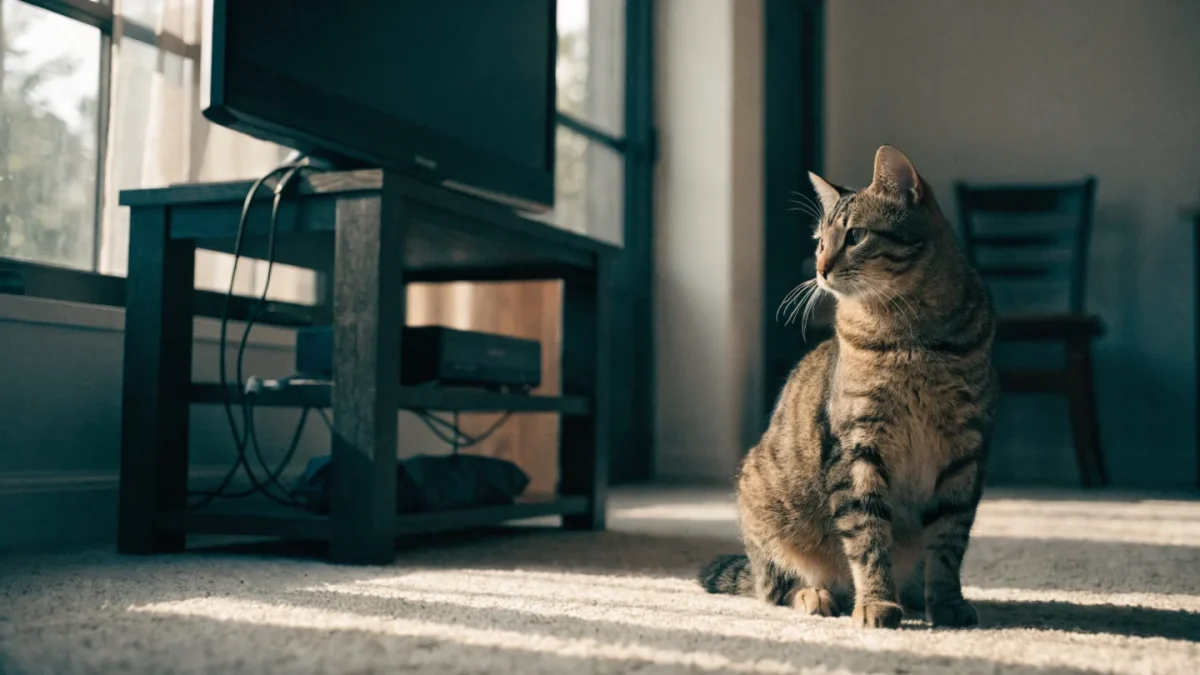
Living rooms and bedrooms feel safe. They're the spaces we share most closely with our pets — couches, beds, throw blankets, gentle evenings. Most people don't associate "living room" with "pet hazard zone" the same way they do the kitchen or garage.
And yet these rooms send a steady stream of animals to my clinic every year.
The hazards here aren't the dramatic, obvious kind. They're the background ones: the lamp cord behind the sofa that nobody thinks about, the looped blind cord that's been hanging at cat-shoulder height for years, the nightstand medication that gets knocked to the floor. Accumulated risk from things that have been fine until they weren't.
Electrical Cords
A puppy or kitten who chews through a live electrical cord receives an electric shock that can cause mouth burns, pulmonary edema (fluid accumulation in the lungs), cardiac arrhythmia, and death. This happens. Not rarely.
Adult dogs and cats who are past the chewing phase are at significantly lower risk — but "past the phase" isn't a guarantee, and bored or anxious pets of any age may chew.
The practical approach:
Route cords behind furniture where possible. Use cord management covers or spiral cord wrap for unavoidable exposed runs. Cable boxes and power strips under entertainment units can be enclosed in cable management boxes (available at any electronics retailer). Unplug and store device chargers when not in use — phone and laptop chargers on the floor are particularly accessible and particularly interesting to cats.
This isn't about perfection. It's about not having a dangling electrical cord at kitten nose level for hours every day.
The electrical cord safety for pets guide covers the hazard mechanism in detail and specific cord-management products.
Blind and Curtain Cords
This is the one that surprises people most. I've personally treated a cat who got a looped cord around her neck. She survived, but she was in oxygen therapy for two days afterward.
The mechanism: cats bat at dangling cords. Loop cords hang at exactly cat play height. The cat bats, gets her head or neck through the loop, and — if the cord doesn't break — she's trapped. Panicking makes it worse. If no one is home to help, the outcome can be fatal.
This is not a theoretical risk. The U.S. Consumer Product Safety Commission has documented hundreds of deaths of both children and animals from looped window covering cords, which is why newer cordless window coverings have become standard, and why the industry now makes cord cleats standard on corded blinds.
Fixes:
- Replace corded blinds with cordless models (a permanent solution)
- Use cord cleats (inexpensive, attaches to the wall near the window frame, allows you to wind excess cord up and out of reach)
- At minimum, cut loops — cut through the bottom of looped cords to create two separate cord ends
The blind cord strangulation risks article has specifics on each type of window covering.
The Recliner Problem
Recliners kill pets. Less commonly than cords, but it's a well-documented hazard.
The mechanism: small dogs, cats, or kittens climb into the underside of a recliner footrest mechanism — it's a warm, enclosed, safe-feeling space. The person using the recliner, not knowing the animal is there, retracts the footrest. The mechanical action crushes whatever is in it.
This is specifically a hazard with smaller animals — a large dog physically can't fit. But kittens, cats, small dogs, and in some cases rabbits and ferrets are at risk.
The fix is behavioral, not structural: check before closing. Develop the habit of looking underneath and giving a light knock before retracting a recliner footrest. In households with small animals, this should be automatic.
Nightstand and Bedroom Medications
The bedroom nightstand is where people keep sleep aids, pain medications, anxiety medications, and supplements. This is where a surprisingly high percentage of medication poisonings I see actually originate — not the kitchen, not the bathroom, but the nightstand.
A knocked-over pill bottle. Medication that rolled under the nightstand. Someone's sleep aid left on the surface without thinking about it.
Melatonin (large doses — the human 10mg version), acetaminophen (Tylenol), ibuprofen, antidepressants, sleep aids, and prescription medications have all poisoned pets who found them in the bedroom.
Medications belong in a drawer or on a shelf, not loose on a nightstand surface. If you take bedside medications, keep them in the closed drawer until you need them.
Toxic Plants
Houseplants are living room staples. The problem is that some of the most common and beautiful houseplants are genuinely dangerous to pets:
Lilies deserve their own warning: in cats, almost all true lily species (Easter lily, tiger lily, daylily, peace lily being the most commonly encountered) can cause acute kidney failure. A cat who eats even a leaf or drinks water from a vase with lilies in it requires immediate emergency treatment. If you have cats, there are no safe lilies in your home.
Others to know: Pothos, philodendron, and dieffenbachia cause oral irritation and GI symptoms. Sago palm (more often a yard plant but occasionally brought indoors) is hepatotoxic. Oleander, azalea, and rhododendron cause cardiac effects.
This doesn't mean you can't have houseplants. It means check the ASPCA toxic plant database (aspca.org/pet-care/animal-poison-control/toxic-and-non-toxic-plants) before buying, and keep anything questionable out of reach of cats who jump.
Small Objects on the Floor
This is less of a "living room specific" issue and more of a universal one, but living rooms tend to accumulate:
- Hair ties and rubber bands
- Children's toys with small parts
- Coins (zinc pennies are toxic to dogs — they cause hemolytic anemia)
- Button batteries (cause severe internal burns if swallowed)
- Remote controls with accessible battery compartments
- Game pieces and Lego
A dog or cat who swallows these may need endoscopic or surgical removal. The floor-level habit: when you get a new puppy or kitten, do a sweep for small objects. Then do it monthly until you've established new habits around where things go.
The Bedroom Specifically
A few bedroom-specific additions:
Under-bed space: This collects objects (pens, nightstand items that got knocked off) and becomes a storage area that may contain hazards you've forgotten about. Cats especially sleep under beds and find everything eventually.
Laundry on the floor: Socks are a top GI obstruction cause in dogs. An underwire bra can cause serious injury. Laundry in a hamper with a closed lid, not on the floor.
Lotions and cosmetics on the dresser: Some topical products — essential oil diffuser liquids, certain topical medications used by humans — are toxic to cats who contact them via paw grooming after walking through spills.
The room-by-room home pet-proofing guide provides the full overview across every space in the home if you're working through a comprehensive audit.
FAQ
Q: My adult cat has lived in my living room for six years without incident. Do I need to worry about cords?
You should still secure looped blind cords — that hazard doesn't diminish with the cat's age because it's a physical trap, not a behavioral one. For electrical cords, a cat who has never chewed them at six years old is at low risk but not zero. If cords are accessible and you've got a cat, securing them costs little and prevents the tail end of cases that do happen in adult cats.
Q: Are any common houseplants completely safe for cats?
Yes. Spider plants, Boston ferns, money trees, bamboo, African violets, orchids, and most succulents are generally considered non-toxic. Catnip and cat grass are actually beneficial. Check aspca.org for confirmation before purchasing anything.
Q: My toddler leaves toys all over the floor. How do I manage the small-object risk for my dog?
The combination of toddler + dog + small objects is extremely common and genuinely requires management. A dog-free zone (baby gate to a room where toys live) during active playtime and a genuine pick-up-at-the-end-of-the-day habit are the practical solutions. It won't be perfect, but reducing access significantly reduces risk.
Q: I've heard diffusers are dangerous for cats. Is this true?
Essential oil diffusers can be a problem for cats for a couple of reasons. Cats lack certain liver enzymes that metabolize some terpenes found in essential oils, making them more sensitive than dogs or humans. Concentrated oils — especially tea tree, eucalyptus, clove, citrus, pine — are toxic to cats. Diffusers used continuously in closed rooms with cats present, or oils applied topically to cats, are the higher-risk scenarios. Occasional use in a well-ventilated room is lower risk. When in doubt, diffuse in areas where cats aren't spending extended time.