

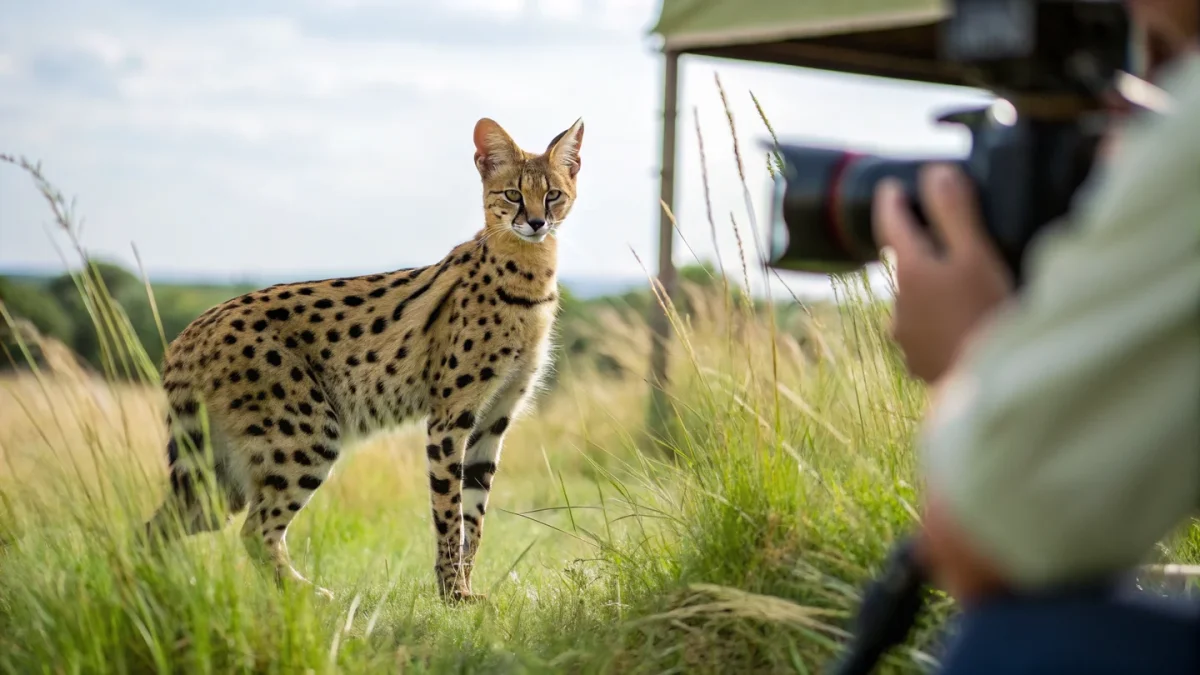
The "F" in F1 Savannah stands for "filial" — a Latin-derived term meaning "of or relating to a son or daughter." In genetics, filial generation numbers describe how many generations of breeding separate a hybrid animal from its wild parent species. It's the same system used for other hybrid animals and plants.
For Savannah cats specifically, the filial number answers a simple question: how many cats ago was there a serval in this cat's direct lineage?
The full context on the breed is in the Savannah cat breed guide.
How the Generations Work
F1: One parent is a serval. The other is a domestic cat. The F1 is approximately 50% serval genetically — that part's just pedigree math, one purebred serval parent. The serval and the domestic cat actually carry the same chromosome count (2n=38 in both), so it's not a karyotype mismatch that complicates things. What complicates it is that "50%" is an ancestry average, not a guarantee of which specific traits show up in any given kitten.
F2: One grandparent is a serval. The F2 was produced by breeding an F1 female (F1 males are typically sterile) with a domestic male or a Savannah male. Approximately 25% serval ancestry.
F3: One great-grandparent is a serval. Approximately 12.5% serval ancestry. Females are reliably fertile from this generation onward; males are more often fertile than in earlier generations but not always.
F4 and F5: These generations see further dilution of the serval influence. F5 Savannahs that have been bred Savannah-to-Savannah for three generations qualify for TICA's "SBT" (Stud Book Tradition) designation, which is the highest registration status and considered the most "true-breeding" Savannah.
F6 and F7: Very small percentage serval ancestry. These cats are largely domestic in behavior, though the spotted pattern and long-legged silhouette often persist. At this generation range, behavior is typically comparable to a highly active domestic breed.
Size by Generation
The size difference between generations is real and significant, but specific numbers require caution.
F1 and F2 males tend to be the largest Savannahs, with some reaching sizes substantially larger than most domestic cats. Weights that make them comparable to larger dog breeds get thrown around a lot, but there's no standardized per-generation weight chart from TICA or anywhere else with real teeth — the numbers you'll see are breeder-reported, not registry-verified, and they describe exceptional individuals more often than typical ones.
F3 and F4 cats are typically noticeably larger than average domestic cats but substantially smaller than F1 and F2 males. The size advantage over domestic cats becomes more moderate with each generation.
F5 and later cats are often in a similar size range to a large domestic breed — comparable to a large Maine Coon, for instance. The filial system used for Savannahs is also used for Bengals, and Bengal cat generations — a parallel filial system from a different hybrid lineage — offers a useful comparison of how generation dynamics play out in a breed that has had decades more time to stabilize. Larger than average, but not dramatically so.
Two important caveats: size variation within a generation is substantial, and the domestic breed used in each cross influences size significantly. An F3 bred from a large Domestic Shorthair will differ from an F3 bred from a smaller Oriental-type cat.
Temperament by Generation
F1: The most complex temperamentally. Strongly bonded to specific individuals, potentially cautious or reactive with strangers, strong prey drive, heightened environmental sensitivity. Not suitable for most households. Require experienced owners who have researched hybrid cat ownership specifically.
F2: Somewhat more manageable than F1, still complex. The bonding capacity is there — F2s can be deeply attached to their households — but the wild-edge behaviors require management and experienced handling.
F3: Often described as the threshold generation for experienced Savannah owners. The complexity begins to resolve into something more workable. Individual socialization matters greatly at this generation.
F4 and F5 (SBT): These generations show the most reliably "Savannah" temperament — highly interactive, curious, dog-like in their attachment to people, playful, and engaging — with temperament more predictable from kitten socialization. Still notably more energetic and interactive than most domestic breeds, but manageable by owners with experience with active cats.
F6 and later: Temperamentally close to a very active domestic cat. The exotic appearance remains; the wild-edge behaviors have largely resolved.
The SBT Designation and Why It Matters
TICA's Stud Book Tradition (SBT) status requires that a Savannah have three or more consecutive generations of Savannah-to-Savannah breeding in all lines. An SBT Savannah is typically F5 or later.
The designation matters because it indicates the breed has been established without fresh serval crosses or domestic outcrosses in the recent lineage. For buyers, SBT Savannahs are more predictable in temperament and appearance, and they can compete in full championship status at TICA shows.
Non-SBT Savannahs (earlier generations, or cats with a recent outcross) may be registered as Foundation (A, B, or C registers), each indicating how many generations of Savannah breeding exist in the pedigree.
What Generation Is Right for You?
The decision depends on experience level, household type, and what you want from the relationship.
If you're new to Savannahs: F5+ SBT cats give you the breed's distinctive appearance and interactive personality with temperament that experienced cat owners can manage.
If you're experienced with Savannahs or hybrid cats and want the full exotic experience: F3 or F4 from a reputable breeder with excellent socialization practices.
F1 and F2 Savannahs are genuinely specialist animals that require specialist owners — committed, experienced, and with appropriate living situations. They're not beginner Savannahs.
And regardless of generation: