

Here's what's actually going on when your cat tears around the apartment at 2am while you're asleep — or more relevantly, while you're stuck at work for eight hours: they're bored, understimulated, and burning off energy the only way they can. Cats are hunters. Even the laziest, fluffiest, most sedentary couch lump has the neural wiring of a predator. Without anything to stalk, chase, or problem-solve, that energy goes somewhere. Sometimes it goes into the couch cushions. I covered play and hunting instincts in full separately — it provides the foundation for what I'm talking about here.
The good news is that solo cat toys and activities have gotten genuinely good over the last few years. My cats, Mochi and Fig, have put most of these through rigorous testing — meaning I've come home to find them knocked across the room, wedged under the fridge, or completely ignored. Here's what actually works.
1. Ball Tracks
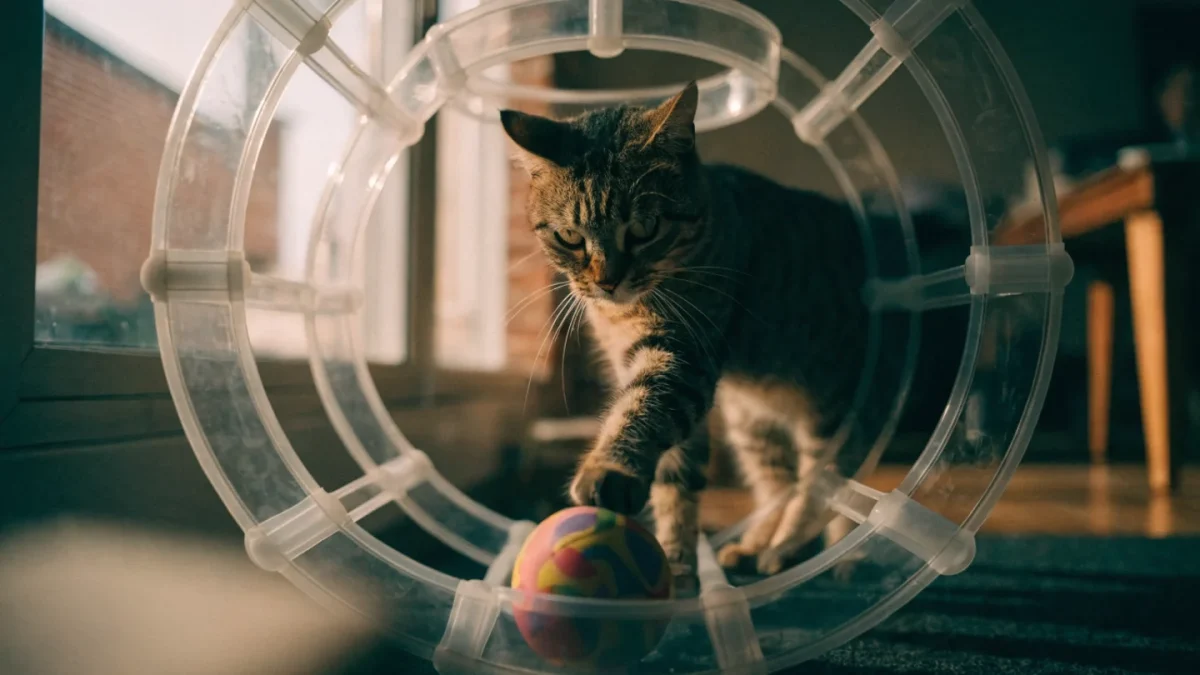
These are probably the most reliable solo toy out there. The concept is simple — a ball or multiple balls are trapped inside a circular or multi-level track, and the cat bats at them as they roll around. There's no skill required from you and nothing to run out of batteries.
What makes a good one: look for tracks with multiple levels or intersecting paths, since a ball that only goes in one direction gets boring fast. Bonus points for ones with a scratching pad in the center — you get two enrichment items in one footprint.
Honestly, Mochi ignored ours for three weeks. Then one Tuesday afternoon, apparently something clicked, and now she uses it every single day. Don't write it off after the first snub.
2. Motorized Wand and Feather Toys
These plug in (or run on batteries) and move a feather, ribbon, or crinkle toy in unpredictable patterns — spinning, flicking, or rotating. The unpredictability is the key. A toy that moves in a perfectly predictable circle loses its appeal within minutes. A toy that suddenly changes direction, speed, or pauses mid-movement holds attention much longer.
Safety note: anything with long strings or ribbons should only come out when you're supervising. For solo use, look for motorized toys where the "prey" component is short, firmly attached, and can't be chewed off and swallowed. If your cat is an aggressive chewer or tends to eat fabric, skip the feather versions entirely.
3. Crinkle Tunnels
Underrated. Enormously underrated. A crinkle tunnel gives cats a place to hide, ambush phantom prey, and make that satisfying crinkling noise when they move through it. Fig goes absolutely feral for tunnels in a way she doesn't for most other toys.
They fold flat for storage, they're lightweight enough that cats can drag them around, and they hold up surprisingly well to claws. Look for ones with a peephole at the top — something about being able to survey the room while hidden really activates that predator brain.
4. Food Puzzles and Treat Dispensers
This is the category that does the most behavioral work. When a cat has to bat, roll, or manipulate a toy to release kibble or treats, they're problem-solving — and that mental effort is genuinely tiring in the best way. A cat that's worked through a food puzzle before you get home is often calmer and more settled than one that's had nothing to do.
Start simple. A basic ball with holes that dispenses kibble as it rolls is perfect for beginners. As your cat figures it out, move to puzzles with multiple steps — things that require sliding compartments, lifting flaps, or reaching through openings. The goal is challenge, not frustration.
One practical note: if you're using a food puzzle with your cat's actual meal (not just treats), account for it in their daily calorie intake. These aren't "extra" — they're the meal, delivered more interestingly.
5. Window Perch with Bird Feeder Outside
This is the closest thing to free enrichment I know of. A window perch — a padded shelf that attaches to the windowsill — gives your cat a comfortable spot to watch the world. If you put a bird feeder just outside that window, you've created what is essentially live television for your cat.
The chattering, the tail-flicking, the intense focused stare — watching birds and squirrels engages the same instincts that play does. Mochi will sit at her window perch for two to three hours on a good bird day, which is more sustained attention than almost any toy achieves.
Look for window perches rated for your cat's weight, with suction cups or brackets that attach firmly. A perch that wobbles when the cat jumps on it will never be used. Stability matters.
For building an enriching home environment for your cat beyond just the window, it's worth thinking about vertical space, scratching surfaces, and how different zones of your home serve different needs — building an enriching home environment for your cat goes into the full picture.
6. Cardboard Box Forts
Free. Infinitely customizable. Cats love them unreasonably.
Cut some holes in a few boxes of different sizes, tape them together at different levels, and you've made something your cat will investigate, sleep in, ambush from, and carry small toys into. The cardboard itself is interesting — it has a texture and smell that's novel compared to the rest of your furniture. Interactive play with your cat unpacks this particular angle in more detail.
I rebuild ours every month or two when the old one gets thoroughly shredded. Fig has opinions about the hole placement. I ignore them and she uses it anyway.
7. Paper Bags (Open, No Handles)
Paper grocery bags — handles removed for safety — are the budget version of a crinkle tunnel. Cats love the sound, the enclosed space, and the ability to hide inside and spring out at nothing.
The handle removal is non-negotiable. String, ribbon, and loop handles can get caught around a cat's neck. Always cut them off before leaving the bag for solo play.
8. Robotic Toys
These have gotten much more sophisticated. The best ones move erratically — changing direction when they hit walls, stopping and starting unpredictably, moving in ways that genuinely mimic small prey. Some have sensors that activate when the cat comes close; others run on timers so they switch on when you're not home.
What to look for: sturdiness matters a lot here. A robotic toy that tips over on the first swat and then stops moving is useless. Look for low, wide designs with a solid base. Also check the battery life — some of these eat through batteries quickly, and a dead toy on day two of your work week isn't much help.
The real question with robotic toys is whether your individual cat is a chaser or an ignorer. Some cats are immediately captivated. Others watch the thing move, decide it isn't a real threat or opportunity, and walk away. If your cat falls in the second camp, robotic toys aren't the problem — they're just not that cat's thing.
On Rotation and the Cat That Ignores Everything
Here's something nobody tells you when they list off great solo cat toys: most cats will eventually get bored of anything left out all the time. The solution is rotation. Keep three or four toys available at once and swap them out every few days. A toy that's been "gone" for a week is genuinely novel again.
If your cat ignores most toys completely, don't panic. Some cats — especially older cats, or very shy cats, or cats who spent a lot of their early life in restricted environments — just don't play the way kittens do. That's not a failure on your part or theirs. For these cats, the window perch and food puzzles tend to be more successful than anything involving movement, because they engage at the cat's own pace.
Also: some cats play better when you've left and they're truly alone. I've set up a cheap camera to check on Mochi and Fig while I'm at work, and Fig does things with her ball track that she absolutely never does when I'm watching. Some cats are just private about their play. That's very on-brand for them.
FAQ
How many toys should I leave out for my cat when I'm at work?
Two to four is a good number. Too many at once and nothing feels special; too few and there's nothing to explore. Rotate what's available every few days rather than putting everything out simultaneously.
Is it okay to leave motorized toys on all day?
It depends on the toy and your cat. Most motorized toys aren't designed to run continuously for eight hours — they'll overheat or drain batteries fast. A timer outlet that runs the toy for 20-minute intervals throughout the day is a much better approach. Check the manufacturer's guidelines on any toy before leaving it unsupervised.
My cat has zero interest in any toys. What's wrong?
Probably nothing. Toy preferences are highly individual and can change with age, health, and environment. Try different categories — some cats only engage with textures (crinkle materials, cardboard), others only with motion. Food puzzles often work on cats that ignore all other toys because food motivation is stronger than play motivation for many adult cats. If a previously playful cat suddenly loses interest in everything, that's worth a vet visit.
What toys are NOT safe to leave out without supervision?
Anything with long strings, ribbons, or cords — including wand toys and linear fishing-rod style toys. Small parts that can be chewed off and swallowed. Toys with loops or handles (like bag handles) that can catch around a neck. The general rule: if it has a part longer than about 5cm that could wrap, knot, or be swallowed, put it away when you leave.