

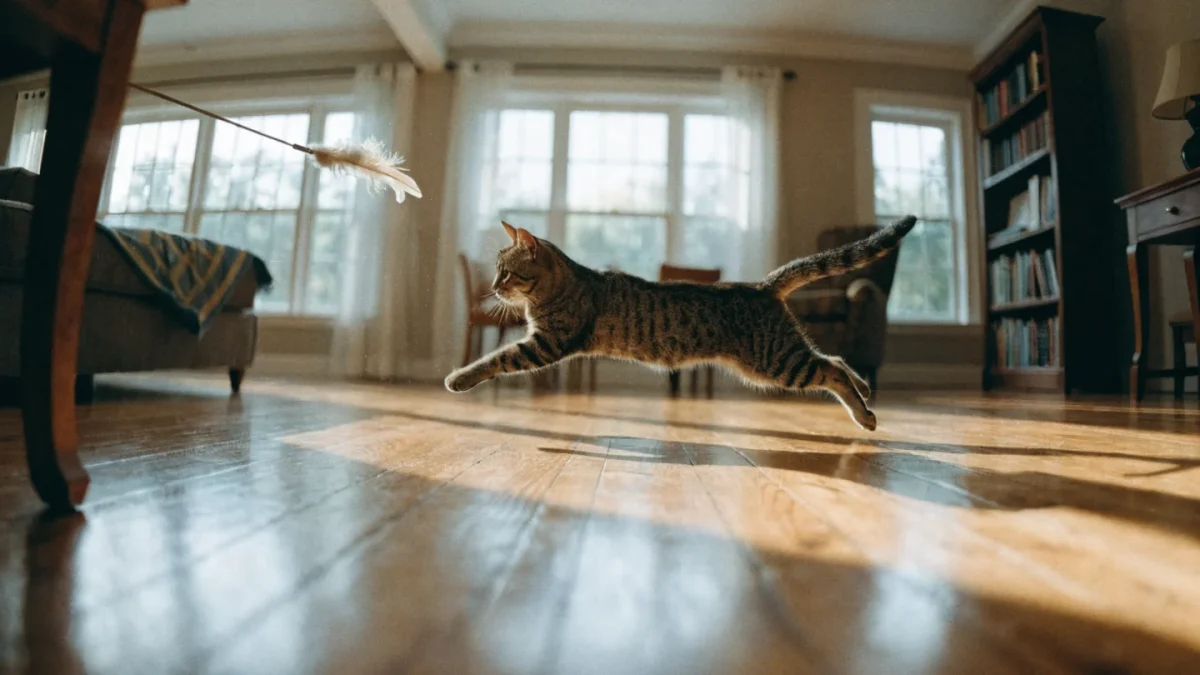
Here's what's actually going on when your cat ignores that expensive toy you waved half-heartedly for thirty seconds: they weren't uninterested in playing. They were uninterested in that — a thing that moved like nothing alive has ever moved. This slots into the bigger conversation about play and hunting instincts.
Interactive cat play isn't complicated, but it does require knowing what you're actually simulating. Once you get that, everything else follows.
Why Interactive Play Matters More Than You Think
Cats are hunters. Not in a vague metaphorical sense — literally, physiologically, neurologically. Their entire sensory system is tuned for detecting, stalking, catching, and dispatching prey. When they don't get to run that sequence regularly, things go sideways. You get a cat who bats your ankles in the hallway at midnight. A cat who tears around the apartment at 3 a.m. A cat who redirects frustration onto your other cat, or onto you.
Interactive play is the outlet. It's how you help your cat complete that hunting cycle in a way that doesn't involve your feet or your furniture.
My cat Noodle was a serial ankle-ambusher for the first two years of her life with me. Once I started doing actual structured play sessions — not just dangling a toy while I scrolled my phone — the ambushes stopped within a week. Not gradually. A week.
The hunting sequence cats need to complete goes roughly: stalk → chase → pounce → catch → kill bite → consume. You can't replicate the last step with a toy, but you can hit all the others. That's the whole goal.
How to Move Toys Like Real Prey
This is where most people go wrong, and honestly it's the single biggest lever you have.
Real prey doesn't hover in midair. It doesn't wave back and forth in a smooth arc. It moves low, moves fast in bursts, freezes, hides under things, and tries to escape. When you move a toy like that, your cat's predator brain lights up.
The basics of prey-like movement:
-
Keep it close to the ground. Birds aside, most cat prey — mice, lizards, bugs — moves along the floor. Drag the toy under a blanket edge. Let it disappear behind a chair leg. Ground-level movement triggers a stronger stalking response than aerial.
-
Move in bursts, not loops. Dart the toy forward two feet, pause. Twitch it slightly, like something catching its breath. Then bolt it sideways. That pause-and-twitch combination is what makes cats go still and low before they pounce.
-
Let your cat catch it. This is the part people skip. If the toy is always just out of reach, your cat gets frustrated — not tired. Every few minutes, slow the toy down. Let them grab it. Let them do the kill bite (that rapid back-foot kick you see when they've got something in their grip). Then slowly "escape" again. The catch-and-release keeps the session satisfying.
-
Use cover. Drag the toy under a throw blanket, along the edge of the couch, around the back of a chair leg. Prey hides. Your cat should have to hunt, not just chase.
Session Length and Frequency
Two sessions a day is the sweet spot for most cats — one before you leave in the morning if possible, and one in the evening. Each session: 10–15 minutes.
That's probably less than you expected, and more than most people actually do. This pairs well with what's going on with solo play.
Honestly, 10 minutes of real, focused play — toy moving like prey, you actually paying attention — exhausts a cat far more than 30 minutes of distracted toy-waving. Quality over duration.
Evening sessions matter especially. Cats are crepuscular, meaning they're wired to be most active at dawn and dusk. A solid play session before bed lines up with their natural rhythm and helps them settle for the night. If you have a cat who wakes you up at 2 a.m., try moving the evening session to right before you go to sleep.
For kittens and younger cats, shorter sessions more often works better than one long one. A six-month-old cat with unlimited energy might do three 10-minute sessions scattered through the day. An older cat might be satisfied with one good session in the evening and a quieter morning one.
Winding Down Play Correctly
Look, this is the step almost nobody does, and it makes a real difference.
When you end a play session abruptly — toy disappears, you get up, session over — your cat's hunting cycle is incomplete. They're revved up with nowhere to put it. That's when the ankle-biting restarts, or they tear across the room bouncing off furniture.
Wind down deliberately. Over the last two to three minutes of a session, slow the toy progressively. Make the movements smaller and less frequent. Let your cat catch and "kill" the toy a few times. Then let it go still.
After play: feed your cat, or give a small treat. This completes the hunt-catch-eat sequence. It triggers a natural wind-down. Many cats will groom themselves and then nap after a play-and-feed sequence. That's exactly what you want.
Reading Overstimulation Before It Becomes a Problem
Most cats give clear signals when they're shifting from "engaged in play" to "about to snap at something." The trick is learning to see them.
Signs your cat is hitting their limit:
- Tail lashing — not the slow curious swish, but rapid, full-tail sweeping
- Skin rippling along their back
- Pupils that have gone fully dilated even in normal light
- Turning to look at your hand rather than the toy
- Low warning sounds — a chirp that sounds more like a complaint than excitement
When you see two or three of these together, slow the session down or stop. Don't abruptly end it (see above) — just gradually reduce the intensity over the next minute or two, then stop.
Some cats, especially those who didn't play much as kittens, get overstimulated faster and stay there longer. With Mochi, my younger cat, I had to learn that her ceiling was about eight minutes before she started redirecting onto Noodle. Now I keep her sessions shorter and watch her tail like a weather vane.
Best Toys for Interactive Play
The toy matters less than how you use it, but some designs do work better than others.
Wand toys with a feather or ribbon attachment are the gold standard. The long handle keeps your hands out of range, the attachment creates distance so the cat focuses on the "prey" not your fingers, and they're versatile enough to create all the movement types described above. Look for a sturdy handle that won't snap mid-session and an attachment you can replace when it wears out.
Toys on a string you can drag along the floor are great for ground-level stalking. Simple, effective, and easy to run under furniture.
Crinkle toys and small plush prey shapes work well as the "catch" toy at the end of a session — something they can grab, bunny-kick, and carry off.
What to avoid: Laser pointers used alone. This one I feel strongly about. The laser triggers the stalk-and-chase response but never lets your cat catch anything. Used exclusively, it's genuinely frustrating for cats and can increase anxiety. If you love the laser for getting your cat moving, always end a laser session by switching to a physical toy they can actually catch. The physical catch matters.
Rough hand play — wrestling with your bare hands, letting a kitten bite and grab your fingers — is another one to avoid. It teaches the cat that human hands are prey. Cute when they're tiny. Less cute when they're adults with a fully developed bite.
Common Mistakes That Undermine Everything
Playing while distracted. Your cat notices when you're half-watching TV. They also disengage when the toy moves mechanically because you're not paying attention. Ten focused minutes beats thirty distracted ones every time.
Always moving the toy the same way. If you've gotten into a loop-and-swipe routine, your cat's predator brain gets bored. Mix up the movement types — slow stalk, fast bolt, hide-and-twitch, ground drag.
Giving up too quickly. Some cats, especially those who weren't played with much as kittens, take a few sessions to fully engage. They might sniff the toy and walk away the first time. Don't interpret that as disinterest in play — interpret it as unfamiliarity. Keep sessions short, keep the movement interesting, and give it a week before drawing conclusions.
Using the same toy every single day. Rotate toys in and out of rotation. Put a toy away for a week and bring it back — suddenly it's interesting again.
FAQ
How do I know if my cat is playing or actually aggressive?
During play, cats are loose and bouncy — they'll pounce, grab, release, and come back for more. Actual aggression is stiffer: ears pinned, low body posture, a cat that grabs and holds rather than releasing. If your cat is drawing blood consistently during play, that's worth addressing with a behaviorist, not just swapping toys.
My cat gets bored mid-session and walks away. What am I doing wrong?
Usually the toy movement isn't convincing enough — too smooth, too predictable, too high off the ground. Try switching to floor-level dragging under furniture and using more pause-and-twitch. Also check session timing — some cats just aren't feeling it at certain times of day.
Can I use automated toys instead of doing it myself?
Automated toys have their place, but they don't replace interactive sessions. The engagement between you and the cat is part of what makes it work — cats respond differently to something that reacts to them versus something on a timer. Use automated toys as enrichment between sessions, not as a substitute.
How young can I start interactive play with a kitten?
As soon as they're mobile and coordinating — around 4 weeks if you're raising neonates, or immediately if you've adopted a kitten who's already past that stage. Kittens learn play rules (don't bite hard, release when you're asked) through play, so starting early actually makes your life easier later.