

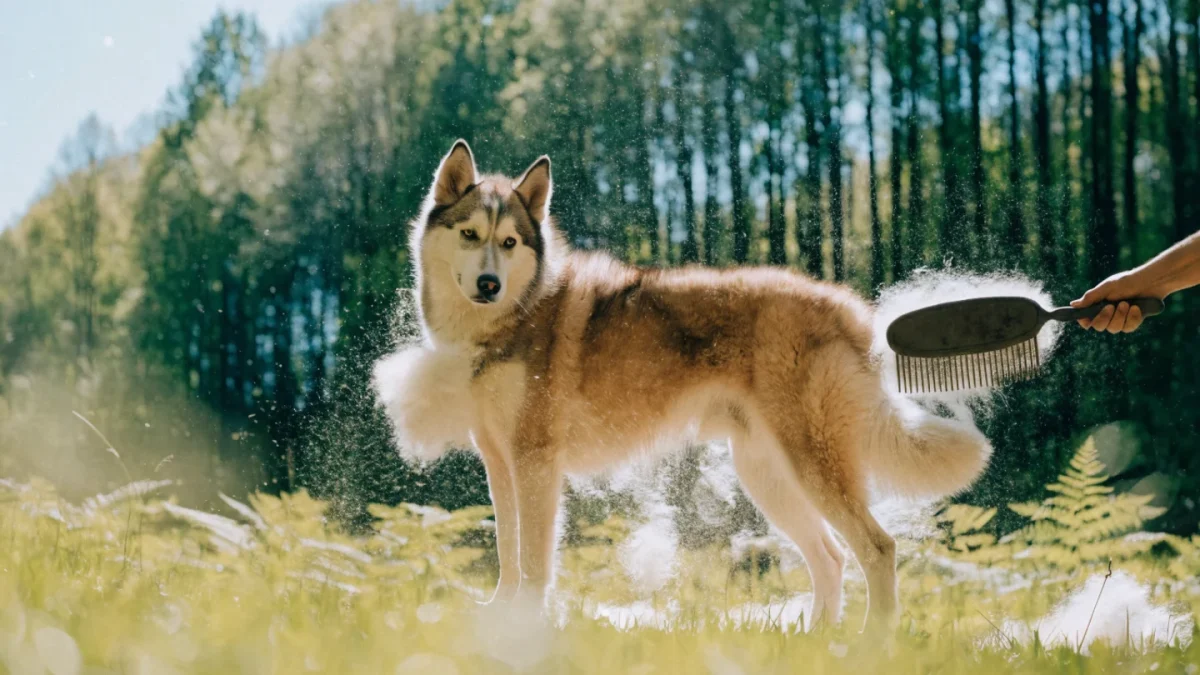
Every April, the same thing happens. A client texts me a photo of their Husky sitting in what appears to be a snowstorm — indoors. Tufts of white undercoat drifting across hardwood floors, clinging to the couch, floating gently off the dog whenever she shakes. "Is this normal?" they ask. Yes. This is entirely normal. This is the blowout.
Double-coated dogs shed their undercoats twice a year — spring and fall — in what can only be described as a controlled explosion of fur. The spring blowout is typically the more dramatic of the two. After months of winter coat retention, the entire undercoat releases at once, triggered by longer days and rising temperatures. For breeds like Huskies, Malamutes, German Shepherds, Samoyeds, and Golden Retrievers, this isn't shedding — it's a complete coat replacement happening over three to six weeks.
Understanding what's actually happening helps you work with the process instead of against it.
What Triggers the Blowout
It's not temperature that triggers seasonal shedding — it's photoperiod, the length of daylight hours. As days lengthen after the winter solstice, the pineal gland registers the change and initiates hormonal shifts that signal the coat cycle to advance. Indoor dogs aren't entirely exempt; artificial lighting delays but rarely eliminates the blowout entirely.
The undercoat — the soft, dense, insulating layer beneath the longer guard hairs — goes through a growth cycle. In spring, the winter undercoat reaches its telogen (resting) phase and begins detaching from follicles. It doesn't fall out all at once; it releases gradually from the skin upward, which is why raking and brushing pull so much material loose even weeks into the process.
The guard hairs remain largely intact throughout. What you're removing is purely undercoat.
The Problem With Doing Nothing
Some owners decide to simply wait out the blowout, vacuuming constantly and hoping it ends soon. This works, technically, but creates two significant problems.
First, the dead undercoat traps against the skin and forms mats — particularly in friction zones like armpits, behind ears, the collar area, and around the base of the tail. Once matted, the material becomes impenetrable to brushing and often requires clipper work to remove.
Second, a clogged undercoat traps heat and moisture against the skin, creating ideal conditions for hotspots (acute moist dermatitis). I've seen dogs come in mid-July still carrying half their winter undercoat, with significant skin inflammation underneath. A spring blowout that isn't managed can become a health issue by summer.
The Right Tools
The wrong tool on a blowing double coat is actively counterproductive. Regular slicker brushes only grab surface fur. Bristle brushes don't penetrate at all.
What you need:
Undercoat rake — This is your primary weapon. Wide-toothed rakes with rotating pins work through the guard hair layer and pull bulk undercoat. Non-rotating versions work too but require more attention to pressure.
Slicker brush — For finishing work after raking. Catches the finer, fluffier material the rake misses and smooths the guard coat.
Deshedding tool — The stainless-steel blade-style tools (often called FURminators generically) are effective for final passes when used correctly. The mistake is overuse — these tools can damage guard hairs if used too aggressively or too frequently.
High-velocity dryer — If you have one, use it. Blasting the coat before and during brushing breaks loose material free from the skin and cuts session time dramatically. This is what professional groomers use to get through a blowout in a fraction of the time.
The Blowout Grooming Sequence
Step 1: Pre-brush or blow out
If you have a high-velocity dryer, blast the entire coat against the grain for five to ten minutes. Watch the undercoat release in visible waves — it's deeply satisfying. Without a dryer, give the coat a thorough pre-brush with your rake just to loosen material before the real session begins.
Step 2: Section and rake
Work in sections rather than random passes. Start at the rear and work forward. Part the guard coat with your free hand and work the rake horizontally through the undercoat, pulling outward from the skin. Each pass should yield visible clumps of undercoat. Continue each section until the rake passes through cleanly — probably four to eight passes per section on a dog in full blowout.
Pay special attention to: the ruff (chest and neck area), behind the ears, the "pants" (thighs), and along the spine. These areas retain the most material.
Step 3: Slicker finish
Once the bulk material is out, switch to a slicker brush. Work through the entire coat to catch the finer fluff and smooth the guard hairs. This step also helps identify any remaining dense spots the rake missed.
Step 4: Check for mats
Before finishing, run your fingers through the coat in high-friction zones. Catch any mats now, while they're small. A mat comb or wide-tooth comb works for minor tangles; more significant mats need a dematting rake or careful slicker work.
Step 5: Optional deshedding tool
If you have a deshedding tool, a single pass on the thighs, back, and ruff can pull the last of the fine undercoat. One pass is enough. Two passes is fine. More than that risks cutting or damaging guard hairs.
Bathing During the Blowout
Bathing dramatically accelerates a blowout — warm water opens the follicle slightly and the mechanical action of lathering loosens dead coat. Followed by a high-velocity blow-dry, a bath mid-blowout is the most efficient way to get through the process in a single session.
The sequence: brush out as much as possible first, then bathe with a moisturizing or deshedding shampoo formulated for double coats, blow dry with high velocity (never cage-dry a dog in blowout — it mats terribly), then do a final brush-through. This approach, done once or twice during the blowout period, often produces better results than daily brushing alone over the same three-week span.
See our complete seasonal grooming guide for how blowout management fits into the full-year routine.
Session Length and Frequency
A dog in full blowout should be brushed every two to three days, for sessions of twenty to forty-five minutes depending on coat density and dog size. Daily brushing is even better if the dog tolerates it. The goal is to stay ahead of mat formation — once the dead coat starts clumping, you're fighting a harder battle.
For most double-coated dogs, the active blowout lasts three to five weeks. After that, shedding drops back to a manageable baseline. For summer coat management after the blowout ends, the priorities shift from removal to maintenance.
When It Won't End
Some owners insist their dog sheds year-round at blowout intensity. This is usually one of three things: a dog that lives mostly indoors under artificial light (disrupts the photoperiod trigger, spreading the blowout out over months rather than weeks), a dog with an underlying health issue (thyroid problems, hormonal imbalances, nutritional deficiencies can all cause chronic excessive shedding), or — most commonly — a dog whose undercoat was never fully removed during the last blowout and is still carrying dead coat months later.
If brushing seems to never make a dent, or the shedding pattern seems completely aseasonal, a vet check is warranted.
A Word on Nutrition
A dog entering blowout season in poor nutritional condition will shed more erratically and the new coat will come in thinner. Omega-3 fatty acids support follicle health and coat quality — fish oil added to the diet during shedding season isn't a magic fix but it does make a measurable difference in many dogs. Adequate protein intake matters too; coat is made largely of keratin, which requires amino acid building blocks.
FAQ
How long does a dog's spring blowout last?
Three to six weeks for most double-coated breeds. Smaller dogs with lighter coats (like Corgis) tend toward the shorter end; large, dense-coated breeds like Samoyeds or Malamutes can stretch toward six weeks or more.
Should I shave my dog to reduce shedding?
No. Shaving a double-coated dog removes the guard hairs along with the undercoat, disrupting the two-layer system that regulates temperature. It doesn't prevent future shedding and can cause "coat funk" — permanent texture changes after regrowth. Regular brushing is the correct approach.
Is it normal for huge tufts to come out?
Yes. During a blowout, it's normal to fill a trash bag with undercoat over a single grooming session. The amount is startling but entirely normal.
Can I use a regular slicker brush for a blowout?
A slicker alone is insufficient — it won't penetrate deeply enough to pull the bulk undercoat. You need an undercoat rake as your primary tool. The slicker is for finishing.
Does bathing make shedding worse?
Bathing followed by proper blow-drying actually gets more coat out faster, which looks like more shedding but actually accelerates the process toward completion. Bathing without blow-drying and leaving the dog to air-dry can cause matting.