

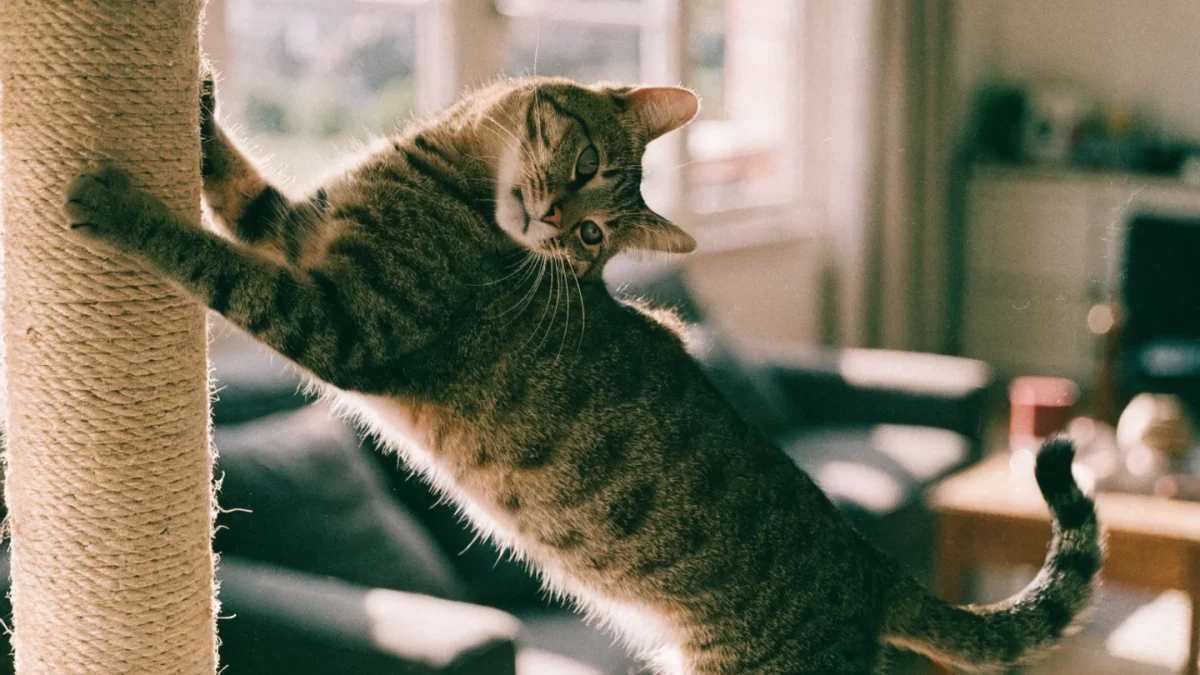
Here's what's actually going on when your cat shreds the arm of your couch: they're not doing it to spite you. Scratching is a hardwired behavior — it keeps their claws healthy, leaves a visual territory marker, and gives their whole upper body a satisfying stretch. The couch just happens to be in a great spot, the right height, and made of a texture that feels perfect under their paws. The foundation for all of this is in why cats scratch and how to redirect it.
To stop your cat from scratching furniture, you need to redirect the behavior, not eliminate it. Give them something better to scratch, make the furniture less interesting, and be consistent for a few weeks. That's the whole strategy — everything below is just the detail of how to actually pull it off.
Why Furniture Is So Appealing in the First Place
The corner of a sofa is, from a cat's perspective, basically a luxury scratching post. It's tall enough for a full stretch, sturdy enough not to wobble, and the woven fabric catches their claws satisfyingly. It's also usually right in the middle of the household — which matters, because scratching is partly about marking territory in high-traffic areas.
My cat Miso went straight for the exact corner of the couch closest to the front door every single morning. The real question isn't "how do I stop this" — it's "what can I put here that she'll like even better?"
Understanding the why makes everything else click faster.
Step 1: Get the Right Scratching Surface
This is the step most people rush, and it's why a lot of scratching posts go completely ignored.
Cats have strong preferences about scratch surface and orientation. Some want vertical posts, some want horizontal pads. Sisal rope and corrugated cardboard are the two most universally accepted materials. Carpet-covered posts are often ignored because carpet doesn't shred in that satisfying way — it just pills.
What to look for in a vertical post:
- Tall enough for a full stretch — most cats need at least 32 inches (80 cm). Short posts mean the cat has to hunch, which defeats the purpose.
- Completely stable — if it wobbles even once, most cats write it off permanently. Heavy base or wall-mount.
- Sisal rope or sisal fabric — rough texture, holds up, actually shreds like bark.
For horizontal scratchers, dense corrugated cardboard is the gold standard. Many cats who ignore posts completely will work a flat cardboard pad for hours.
Honestly, buy one of each style first and see which your cat actually uses. Watching where and how they currently scratch your furniture tells you a lot — a cat who goes for the low edge of a couch cushion probably wants horizontal.
Step 2: Place Scratchers Strategically
Location matters more than most people expect.
Put the new scratcher right next to the piece of furniture being scratched — not across the room, not in "a better spot" according to your living room aesthetic. Right next to it. The idea is to intercept the behavior at the moment it happens, not redirect the cat to a different room.
Once your cat is reliably using the scratcher in that spot (usually a few weeks), you can inch it gradually to where you'd prefer it to live. Move it six inches every few days. If scratching the furniture starts up again, you've moved too fast — slide it back.
For a multi-cat household, the math is simple: one scratcher per cat, plus one extra. Competition over scratching spots leads to stress scratching, which makes the whole problem worse.
Step 3: Make the Furniture Less Appealing
Redirection works faster when you also reduce the appeal of the original target. You're not punishing your cat — you're just making the furniture temporarily less satisfying while the new scratcher gets established.
A few things that actually work:
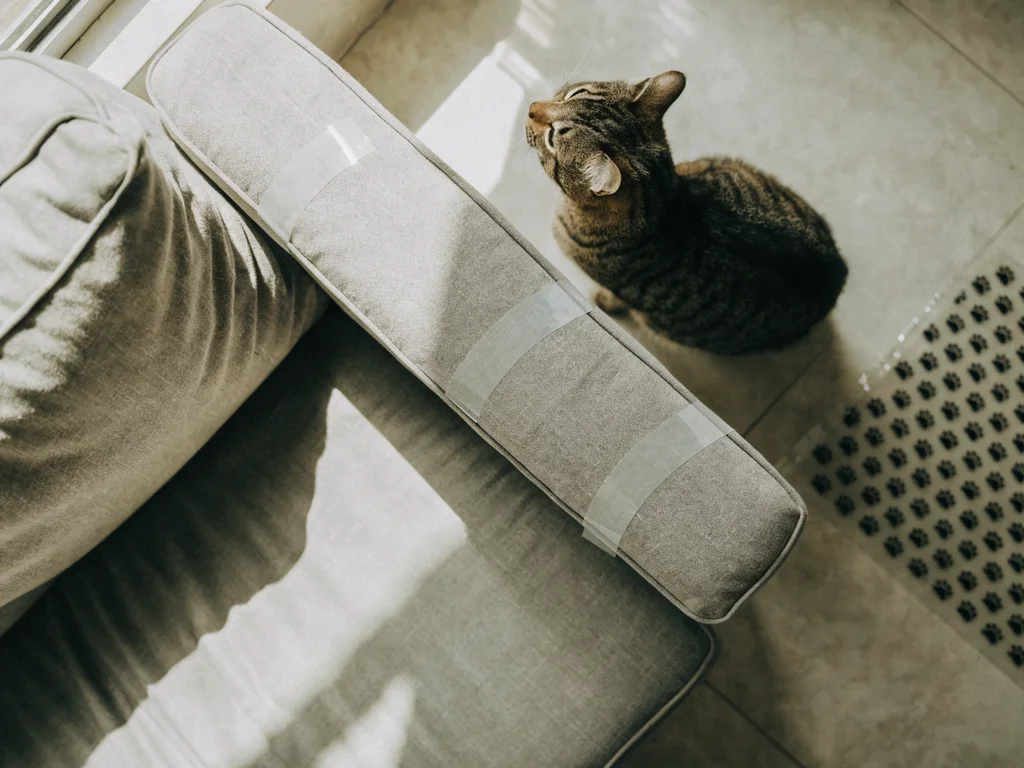
Double-sided tape applied to the scratched area. Cats hate sticky textures on their paws. Specialized pet furniture tape tends to be less damaging to upholstery than generic tape, but test a hidden corner first regardless. This is a temporary measure — you peel it off once the habit has shifted.
Plastic corner guards or sofa protector panels. These cover the scratched area entirely and can be found in clear versions that barely show. Not elegant, but effective, and they come off cleanly.
Aluminum foil draped over the scratched area. Sounds ridiculous. Works anyway. Most cats dislike the texture and sound. Usually only needed for a week or two.
What you want to avoid: spray-on deterrents that smell unpleasant. Some cats ignore them entirely, and the ones that work can make the whole room smell like citrus or bitter apple to everyone in the house. The physical barriers are more reliable.
Step 4: Reward Use of the Scratcher — Consistently
Every time your cat uses the scratcher, mark it. A small treat, a verbal "yes," or even just enthusiastic attention. You're building an association that this object = good things happen.
If you catch your cat starting to scratch the furniture, a calm "no" and then physically guiding them to the scratcher is more effective than a loud correction. Startle them away from the furniture and immediately show them the alternative. The goal is for the scratcher to feel like the obvious next move, not a consolation prize.
Catnip can help in the early days. Rub dried catnip into sisal or sprinkle it on a cardboard pad to make the scratcher more interesting from the start. This works especially well for cats who seem indifferent to new items. Not every cat responds to catnip — sensitivity is genetic, and some cats never develop a response to it — but for the ones who do, it's a useful shortcut.
Step 5: Trim Claws Regularly
This doesn't stop scratching behavior — cats scratch even with trimmed claws — but it reduces the damage significantly and makes furniture recovery faster while you're working on the redirect.
Trim just the sharp tip of each claw, avoiding the pink quick. Every two to three weeks is usually enough for indoor cats. If your cat is resistant, work up to it slowly: one paw per session, lots of treats, never force it. A cooperative cat who gets two paws done is better than a traumatized cat who gets all four done once and never trusts you again.
When It's Not Working
If you've had a scratcher in place for four weeks, tried the deterrents, and your cat is still going straight for the furniture — look at the scratcher itself first. Is it stable? Tall enough? The right material? Is it actually near the area they're targeting?
Sometimes the answer is just trying a different style. A cat committed to your couch's fabric texture might respond to a carpet-free sisal wrap you can hang on the side of the couch itself. Meeting them exactly where they already are removes any friction.
Stress can also drive excessive or redirected scratching. A new pet, a move, construction noise, schedule changes — any of these can increase scratching intensity. If the behavior spiked suddenly alongside a change in the household, the root issue is anxiety, not the furniture.
FAQ
Will a scratching post really make my cat stop scratching the furniture?
Usually yes, if you choose the right post and put it in the right place. The failure mode is almost always a post that's too short, too wobbly, or sitting in the wrong room. Cats aren't going to walk past a perfectly good couch to scratch something in a back bedroom.
Is it okay to use a spray deterrent on the furniture?
Spray deterrents (citrus, bitter apple, etc.) work for some cats and do nothing for others. They're not harmful, but they're inconsistent and can be unpleasant for the whole household. Physical barriers — tape, plastic covers — tend to give more reliable results.
Should I declaw my cat to stop furniture scratching?
Declawing is a surgical amputation of the last bone of each toe, not a nail trim. It's banned or strongly discouraged by veterinary associations in many countries, and it doesn't resolve the scratching impulse — it just leaves the cat without the ability to act on it, which creates other behavioral and physical issues. Redirection is both more humane and more effective long-term.
My cat only scratches the furniture when I'm watching. Is that spite?
Cats don't do spite. What's more likely: your cat has learned that scratching the furniture gets your attention — any attention, including "no!" — and attention is rewarding. The fix is to ignore the furniture scratching entirely (no reaction) and make a bigger deal of scratcher use instead. It takes a week or two, but the behavior usually fades when it stops generating a response.