

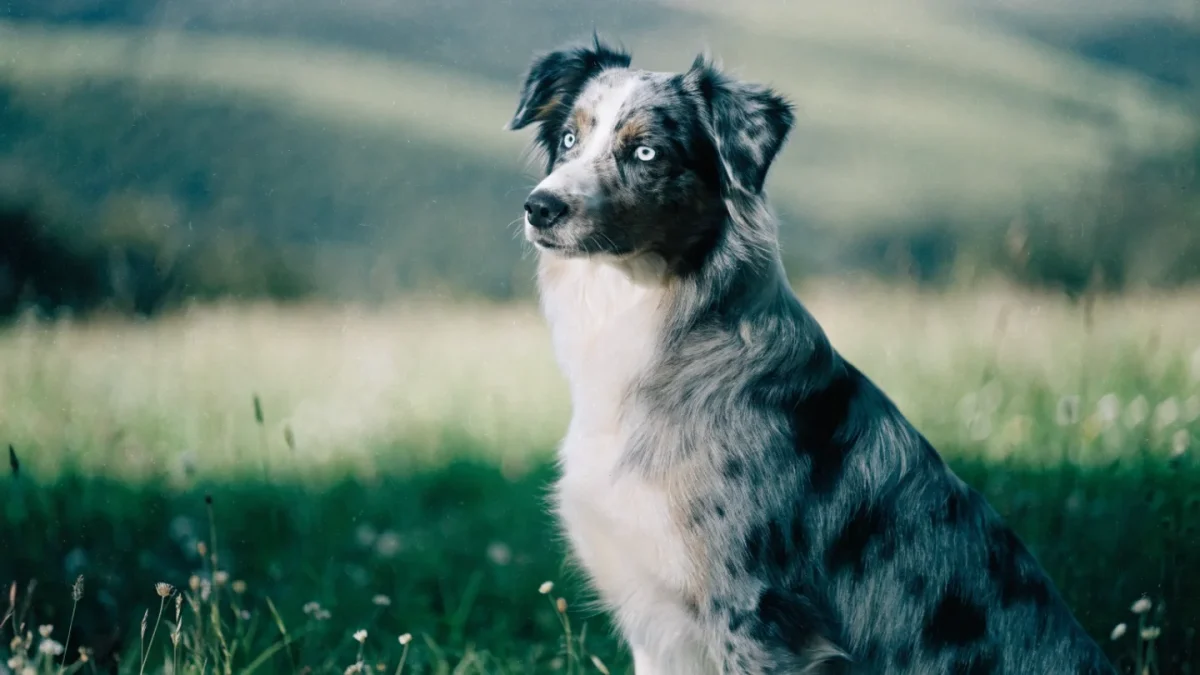
Spend enough time at Australian Shepherd specialties and you start seeing the double-merle dogs — the ones with the white faces, the pale or blue eyes that track slightly wrong, the handlers who know exactly what they're working with. Most are rescues or breeder takebacks. The condition is always the same: two copies of the merle gene, one from each parent, producing the homozygous state that the breed community calls "lethal white." Not always lethal. Sometimes just deaf. Sometimes blind. Sometimes both, in combination with microphthalmia — undersized eyes that developed abnormally in the womb because the pigment-disrupting mechanism that makes a single merle beautiful had nowhere to stop.
I've watched breeders at those shows wince when someone walks past with a double-merle. Not a judgmental wince — a tired one. Because this outcome is entirely, completely preventable. You don't breed merle to merle. That's it. The science behind why has been understood at the molecular level since researchers identified the PMEL17 gene as the merle mechanism. The genetics behind australian shepherd merle patterns aren't complicated. The problem is that the pattern is beautiful and fashionable, and "cryptic merle" dogs can look solid-colored while still carrying one merle copy, meaning the mistake sometimes happens without the breeder realizing both parents were merle. That's where the genetics of this breed get genuinely complicated — and genuinely important to understand.
The Merle Gene: How It Works
The merle pattern is caused by a SINE insertion (a type of mobile genetic element) in the PMEL17 gene on chromosome 10. This insertion disrupts normal melanocyte function — the cells that produce pigment in the skin, coat, and eyes. The disruption is random and incomplete, which is why merle dogs have irregular patches of full-color pigment interspersed with diluted (lighter) areas, creating the characteristic marbled appearance.
The key genetic detail: merle is semi-dominant. A dog needs only one copy of the merle allele (heterozygous, Mm) to express the merle pattern. A dog with no copies (homozygous non-merle, mm) is solid-colored. A dog with two copies (homozygous merle, MM) is a double merle.
The SINE insertion that causes merle varies in length between individuals, and this length variation affects how the gene expresses. Longer insertions tend to produce more pronounced merle patterning. Shorter insertions can produce subtle merle expression — sometimes so subtle that the dog appears solid-colored. These "cryptic merles" or "phantom merles" are genetically merle but don't look it, which creates a breeding hazard when visual assessment alone is used to determine merle status.
The Double-Merle Problem
When two merle dogs (Mm x Mm) are bred, basic Mendelian genetics predicts the following average outcome per litter:
- 25% homozygous non-merle (mm) — solid-colored, unaffected
- 50% heterozygous merle (Mm) — merle-patterned, unaffected
- 25% homozygous merle (MM) — double merle, at high risk for deficits
Double merles are predominantly white or very lightly pigmented because the doubled effect of the merle gene severely reduces melanocyte survival across the coat, eyes, and inner ear. The connection between pigmentation and sensory function is direct: melanocytes in the inner ear (specifically in the stria vascularis of the cochlea) are essential for normal hearing, and melanocytes in the eye contribute to normal ocular development.
The consequences for double-merle dogs include:
- Deafness. Unilateral (one ear) or bilateral (both ears). The absence of cochlear melanocytes disrupts the endolymph ionic environment required for auditory signal transduction.
- Blindness. Resulting from microphthalmia (abnormally small eyes), anophthalmia (absent eyes), iris colobomas (gaps in the iris), or other structural ocular defects.
- Combined sensory loss. Some double merles are both deaf and blind.
- Increased UV sensitivity. Heavily depigmented skin lacks melanin protection against ultraviolet radiation.
The term "lethal white" is sometimes applied to double merles. It's a misnomer borrowed from horse genetics — the condition isn't lethal in itself, and affected dogs can live full lifespans with appropriate care. But the sensory deficits are significant, often severe, and entirely preventable through responsible breeding.
The complete breed guide identifies merle-to-merle avoidance as one of the foundational principles of responsible Australian Shepherd breeding. No credible breeding program produces double merles. DNA testing for merle status is widely available and affordable.
Cryptic Merles and Testing
The variable expression of the merle gene creates a practical problem: not all merle dogs look merle. Cryptic merles carry a shorter SINE insertion that produces minimal or no visible merle patterning. To the eye, they appear solid. Genetically, they can pass the merle allele to offspring.
If a cryptic merle is mistakenly bred to an obviously merle dog, the resulting litter carries the same 25% double-merle risk as any other merle-to-merle cross. This is why responsible breeders DNA-test for merle status rather than relying on visual assessment. The test identifies the SINE insertion regardless of how strongly it expresses in the coat.
Merle testing is available from multiple veterinary genetics laboratories and costs relatively little per dog. Given the severity of the double-merle outcome, there is no cost-benefit argument against testing.
Eye Color Genetics
Australian Shepherds are famous for their eye color diversity — brown, amber, blue, green, and combinations including heterochromia (two different-colored eyes) and split eyes (two colors within a single iris). The genetics behind this are more complex than the coat color story.
Blue eyes in Australian Shepherds can result from at least two distinct mechanisms. In merle dogs, blue eyes are caused by the same pigment disruption that creates the merle coat pattern — melanocyte reduction in the iris results in a structurally colored blue appearance (similar to why the sky appears blue; there is no blue pigment involved). In non-merle dogs, blue eyes appear to follow a separate genetic pathway — potentially related to the same chromosome 18 duplication near the ALX4 gene identified in Siberian Huskies, though the full genetic picture in Australian Shepherds is still being characterized.
Heterochromia — one blue eye and one brown eye, for example — occurs when the merle gene's random pigment disruption affects the two eyes differently. One iris retains enough melanocytes for brown coloration while the other doesn't. This is purely cosmetic and has no effect on vision quality in heterozygous merle dogs.
Amber eyes — a lighter, golden-brown color — are associated with the red (liver) color base. Red and red merle Aussies frequently have amber rather than dark brown eyes because the brown dilution gene (bb at the B locus) reduces eumelanin intensity in the iris as well as the coat.
The practical takeaway: eye color in Australian Shepherds is genetically complex, visually striking, and — in single-merle or non-merle dogs — cosmetically variable without health implications. The only eye color concern is in double merles, where iris defects like colobomas are structural problems rather than color variations.
MDR1: The Drug Sensitivity Gene
The MDR1 mutation (Multi-Drug Resistance 1, now formally called ABCB1) is not related to coat color or merle, but it's the second most important genetic consideration in Australian Shepherds.
The ABCB1 gene produces P-glycoprotein, a transport protein that functions as a pump in the blood-brain barrier, intestinal lining, and other tissues. P-glycoprotein's job is to move certain molecules — including many drugs — out of the central nervous system and back into the bloodstream. In dogs with the MDR1 mutation, this pump is defective.
The result: drugs that are normally excluded from the brain accumulate in the central nervous system, reaching toxic concentrations. The most historically significant example is ivermectin, a common antiparasitic. Dogs with two copies of the MDR1 mutation (mutant/mutant) can develop severe neurological toxicity — tremors, blindness, seizures, coma, death — from ivermectin doses that are perfectly safe for dogs with functional P-glycoprotein.
The list of affected drugs extends well beyond ivermectin and includes loperamide (an antidiarrheal), several chemotherapy agents, and certain anesthetic protocols. Approximately 50% of Australian Shepherds carry at least one copy of the mutation, and roughly 25% are homozygous (mutant/mutant) with full sensitivity, based on Washington State University screening data.
Every Australian Shepherd should be MDR1 tested. The test is a simple cheek swab, results are permanent (the genotype doesn't change), and the information is essential for safe veterinary care throughout the dog's life. MDR1 testing is non-negotiable baseline knowledge for any Aussie owner.
What the Genetics Mean for Owners
Australian Shepherd genetics aren't just academic. They translate to specific, actionable responsibilities:
- Know your dog's merle status. Test, don't guess. If you breed, never cross two merles.
- Know your dog's MDR1 status. Test once, inform every veterinarian who treats your dog, for life.
- Understand that eye color diversity is normal. Blue eyes, heterochromia, and amber eyes are part of the breed's genetic landscape. In single-merle and non-merle dogs, they're cosmetic variation, not defects.
- Screen breeding stock comprehensively. Merle, MDR1, CEA, PRA, hip, and eye evaluations form the minimum panel. The breed's genetic complexity rewards informed decision-making and punishes shortcuts.
The history of the breed explains how function-first breeding by Basque shepherds and western ranchers produced the genetic diversity that defines modern Australian Shepherds. That diversity is a strength — but it requires genetic literacy from the humans who manage it. Owners researching herding breed genetics more broadly will find Border Collie genetics, merle inheritance, and CEA a closely parallel reference — the two breeds share the merle gene and some overlapping health markers, though their genetic risk profiles diverge in significant ways.