

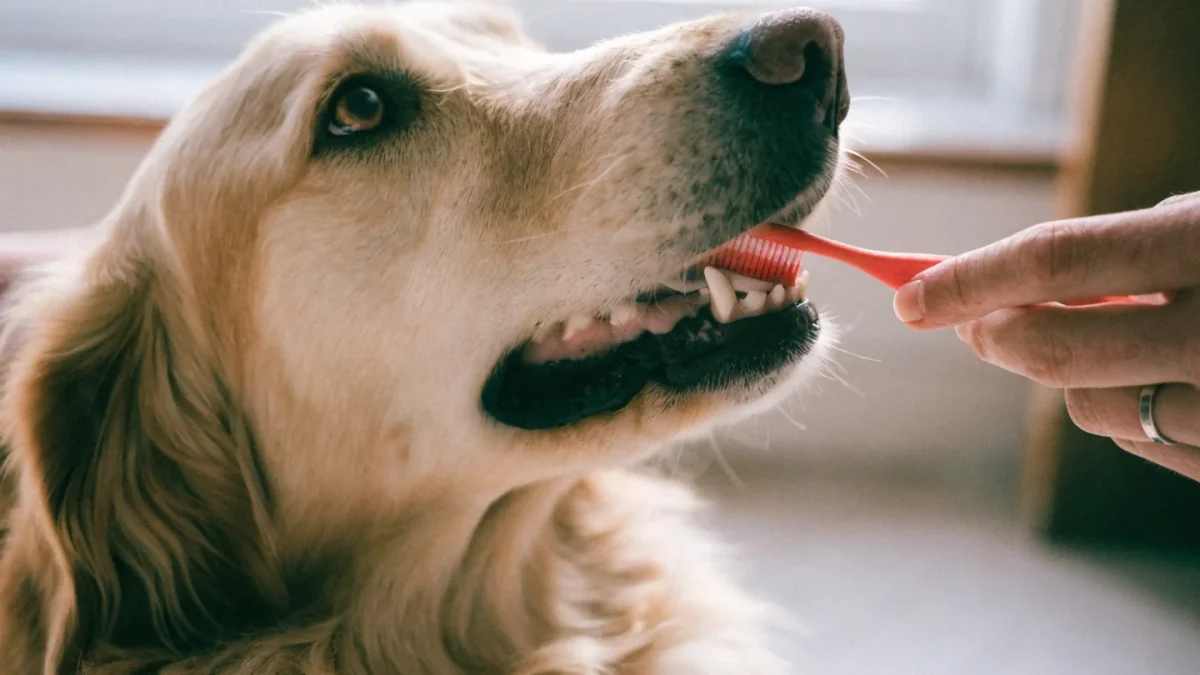
Most dogs will accept tooth brushing once they associate it with something positive. The problem is that most owners attempt it wrong — grabbing the dog, forcing the mouth open, scrubbing, done. The dog panics, the owner gives up, the teeth deteriorate. The approach matters as much as the frequency. For the full context on why dental care matters so much, the complete guide to pet dental care covers disease progression, professional cleanings, and breed-specific risk.
Done right, tooth brushing takes about two minutes and becomes a routine the dog walks up for. I've watched owners transform genuinely resistant dogs in four weeks with the right conditioning sequence. Here it is.
The Conditioning Sequence
Don't introduce the brush on day one. That's too much, too fast.
Days 1–3: Flavor introduction. Put a tiny amount of pet toothpaste on your fingertip and let the dog lick it off. That's the entire session. The goal is creating a positive association with the taste and with the experience of something touching near their mouth from you. Pet toothpastes come in poultry, beef, peanut butter, vanilla-mint — find which flavor your dog shows the most enthusiasm for.
Days 4–7: Finger gum contact. Wrap a piece of gauze around your finger or use a finger cot. With toothpaste on it, rub along the outer surface of the back teeth and gums. Keep it brief — 15–20 seconds per side. The dog should be voluntarily staying for this; if they're pulling away, slow down.
Days 8–14: Introduce the brush. Use a soft-bristled dog toothbrush (or a child's soft-bristled brush — both work). Let the dog sniff and lick the brush. Then apply toothpaste and brush just the front teeth for 10–15 seconds. Stop while the dog is still comfortable.
Week 3 onward: Full mouth. Gradually extend brushing time toward the back teeth. By week 3–4, most dogs are accepting a complete 2-minute session.
The cardinal rule: end every session before the dog gets uncomfortable. A 20-second session that ends on a positive note is worth more than a 3-minute struggle. You're building a behavioral history, not just cleaning teeth.
The Actual Technique
Once your dog accepts brushing, technique determines how effective it is.
Positioning: Sit on the floor or use a table — whatever keeps the dog at a comfortable height for both of you. You should be calm, not hovering. Side-by-side works better than face-to-face for many dogs; being stared at directly can feel threatening.
The mouth: You don't need to force the mouth open. For most dogs, you just lift the lip on one side to expose the teeth. The outer surfaces — the cheek side — are where most tartar accumulates. The inner (tongue-side) surfaces matter less because the tongue provides some natural cleaning action there.
The brush angle: 45 degrees to the gumline. This is the key that most people miss. You're not just scrubbing the white part of the tooth — you're aiming the bristles into the gap where tooth meets gum (the sulcus), which is where plaque at the gumline accumulates. Small circular strokes or gentle back-and-forth motions, working along the gumline.
The sequence: Start with the upper back teeth (the carnassials — the large upper fourth premolars right in front of the molars). These are the teeth most prone to tartar accumulation because three salivary gland ducts open adjacent to them, constantly bathing them in mineral-rich saliva. Upper back molars, then upper incisors and canines, then repeat for the lower jaw.
Time: Two minutes total for a thorough session. This isn't much. Set a timer the first few times until you have a sense of the pace.
Toothpaste: Pet-formulated only. Human toothpaste contains fluoride (toxic to dogs in the quantities involved with swallowing) and commonly contains xylitol (acutely toxic to dogs). Pet toothpastes are safe to swallow — no rinsing required.
How Often Is Often Enough
Daily brushing is the standard recommendation. Here's why the frequency matters: plaque begins mineralizing into tartar within 48–72 hours in some animals. Once tartar forms, brushing can't remove it — only professional scaling can. If you brush every day, you never allow plaque to mineralize. If you brush once a week, you're removing soft plaque but allowing calculus to build up in the intervals.
That said: every-other-day brushing provides substantial benefit and is realistic for most households. The key is the regularity, not perfection. Brushing four or five times a week beats twice-monthly deep scrubbing sessions by a wide margin.
A few times a week plus supplemental dental chews on non-brushing days is a reasonable real-world protocol for busy households.
When Your Dog Resists
Some dogs are harder to condition than others. Adult dogs who've never had their mouth handled are starting from a deficit. Here's what helps:
Rule out pain first. If a dog is suddenly more resistant than usual, or if they flinch when you touch a specific area, there may be a dental problem already present. Have the vet examine before continuing. Brushing a painful tooth creates a strong negative association that undermines all your conditioning work.
Use higher-value treats. If the dog is lukewarm on toothpaste licking but wild for chicken, use small chicken pieces as the reward after each session. The toothpaste flavor matters less than the post-session reward for resistant dogs.
Try different brush types. Some dogs tolerate a finger brush better than a handled toothbrush. Some prefer ultra-soft bristles. Some do better with a double-headed brush that hits both outer and inner tooth surfaces simultaneously. Experiment.
Shorter, more frequent sessions. A resistant dog benefits from multiple 30-second sessions a day more than a single 2-minute struggle.
Desensitize the muzzle first. If the dog pulls away from any face/mouth contact, back up to basic muzzle desensitization — touching the face from different angles with treats, gradually progressing to lip lifts before toothpaste enters the picture at all.
Alternatives When Brushing Fails
Some dogs simply won't tolerate brushing regardless of conditioning effort — severe prior trauma, extreme muzzle sensitivity, or behavioral issues that make handling unsafe. Options:
VOHC-accepted dental chews: Specific enzymatic or textured chews with the Veterinary Oral Health Council seal of acceptance have published evidence for plaque and tartar reduction. Not as effective as brushing but meaningfully better than nothing.
Prescription dental diet: Hill's t/d and Royal Canin Dental are formulated so the kibble's fiber matrix wraps around the tooth before fracturing, providing a mild abrasive cleaning effect. Effective as a supplemental measure.
Water additives: Antimicrobial liquids added to the water bowl. Weakest evidence of the alternatives, but some benefit.
More frequent professional cleanings: If home care is minimal, plan for annual professional cleanings under anesthesia rather than the every-2–3-year schedule a well-maintained dog might manage.
Signs You Need a Vet Dental Visit Now
Regardless of where you are in your home dental care routine, these warrant prompt veterinary attention rather than more brushing:
- Visible brown or gray crusting at the gumline that brushing doesn't remove
- Red, swollen, or bleeding gums
- Any tooth that appears darker than normal (possible dead tooth)
- Dropping food during eating or difficulty chewing
- Persistent bad breath that doesn't improve with cleaning
- Swelling under an eye (often indicates a carnassial tooth root abscess)
Home dental care is maintenance, not treatment. Once disease is present, professional intervention comes first. Then home care maintains the result.
Frequently Asked Questions
Can I use a human toothbrush?
A child's soft-bristled toothbrush works fine. Adult human brushes are usually too large for smaller dogs. The key spec is soft bristles — medium or firm bristles are too abrasive for dental enamel and gum tissue.
My dog won't open their mouth. Do I need to?
No. For the outer surfaces (which are the priority), you just lift the lip. Only if you want to reach inner surfaces do you need mouth opening, and for most dogs this is genuinely optional — the tongue handles inner surfaces reasonably well.
What if there's bleeding?
A small amount of gum bleeding when you first start brushing, on inflamed gum tissue, is common and resolves as gum health improves with consistent brushing. Heavy bleeding, or bleeding that doesn't diminish over 2–3 weeks of consistent brushing, warrants a vet examination — the underlying inflammation needs professional treatment.
How young can I start?
Start as early as possible — 8 weeks old is not too early to begin mouth handling and conditioning. Puppies who learn to accept brushing during the socialization window (up to 16 weeks) typically tolerate it far better as adults than dogs who first encounter it at 2 or 3 years old.