

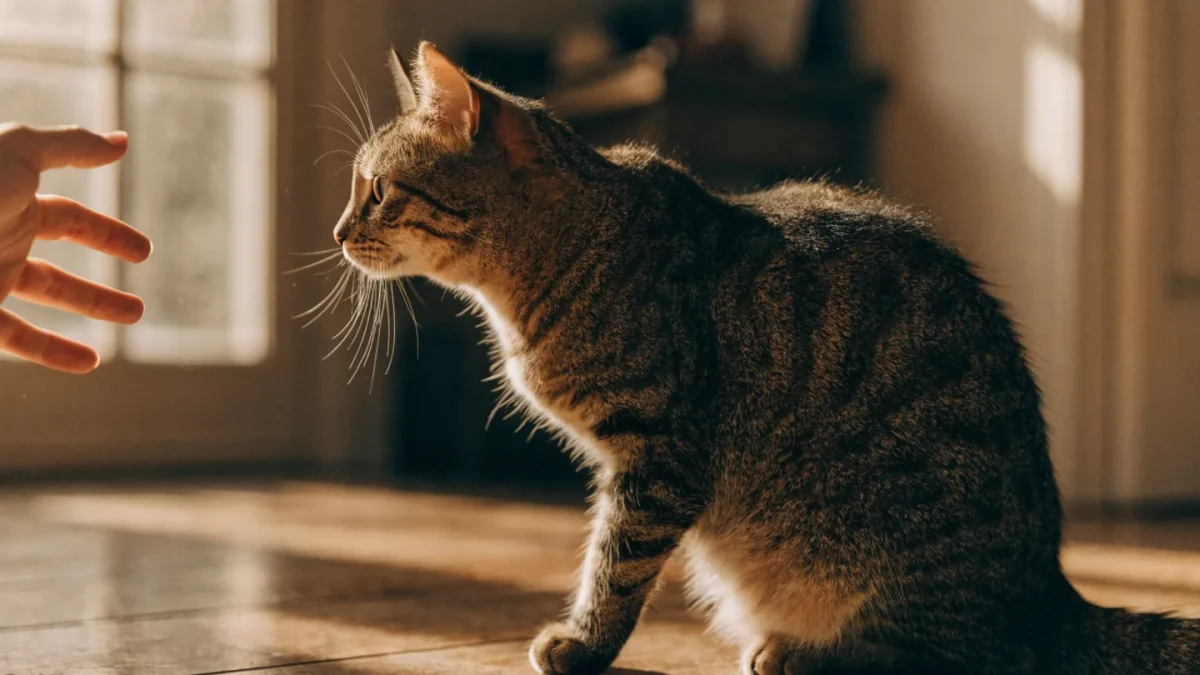
Here's what's actually going on when people say their cat "can't be trained" — they tried once, the cat walked away, and they gave up. Training a cat looks nothing like training a dog, and the moment you understand that, the whole thing clicks. For context on where this fits, cat training covers the full landscape.
My cat Mochi learned to sit on cue within a week. Not because she's exceptionally smart (she once knocked a full water glass onto my laptop twice in the same day), but because I was using the right approach. Cats are absolutely trainable. They just require shorter sessions, better treats, and a willingness to stop the second they lose interest.
These are 10 cat tricks to teach your cat — starting with the basics and working up to the ones that genuinely impress people.
Before You Start: The Three Rules That Actually Matter
Short sessions. High-value treats. End on a win.
That's it. Sessions should be two to five minutes, max. The moment your cat looks away, yawns, or walks off, you're done for the day. Pushing through doesn't build persistence in cats — it builds avoidance. Use whatever treat makes your cat's pupils go wide: small bits of cooked chicken, tuna flake, a special soft treat. Dry kibble works for some cats and does nothing for others.
Clicker training makes all of this easier. The click bridges the gap between the behavior and the reward, giving your cat precise feedback. But it's optional — a verbal marker like a bright "yes!" works just as well once your cat understands what it means.
1. Sit
The foundation of everything. Most cats already sit — the trick is getting them to do it on cue.
Hold a treat just above your cat's nose and slowly move it back over their head. Their nose follows the treat up, their rear end goes down. The second their backside hits the floor, click or say "yes" and give the treat. Add the word "sit" once they're reliably doing the motion. Within a few days, you can fade out the hand signal entirely.
Mochi nailed this in four sessions. Then refused to do it for two days just because. Very on-brand.
2. Stay
Honestly, "stay" is less a separate trick and more a duration extension of sit. Once your cat is sitting on cue, ask for sit, wait one second before rewarding, then two, then five. Build gradually. Don't jump to ten seconds in session two — cats aren't building patience the way you might think. They're learning that the reward is coming, just slightly delayed.
Keep your body still while they're holding position. Any movement from you reads as "we're done" and they'll break.
3. Come When Called
This one's genuinely useful, not just impressive. Start by saying your cat's name followed by "come" in an upbeat tone — and immediately reward when they show up. Do this consistently at feeding time, at playtime, any time they're already walking toward you anyway.
The goal is to make their name plus "come" a reliable predictor of something great. Never call them to you for something they don't like (nail trimming, baths, going in a carrier) — that undoes months of work fast.
4. High Five
This one gets the most reactions from guests.
Hold a treat in your closed fist at your cat's chest height. Most cats will paw at your fist trying to get the treat. When they touch your hand with their paw, click and open your fist. Once they're reliably pawing your closed hand, open your palm and present it. Add "high five" as the verbal cue.
Some cats go full exasperated-slap with this one. Mochi's high five is less "celebration" and more "get out of my way." Still counts.
5. Spin
Hold a treat at your cat's nose level and slowly arc it in a circle — your cat will follow it in a tight spin. Click and reward the moment they complete the circle. This one comes together quickly because the motion is fluid and the reward is immediate.
You can teach clockwise and counterclockwise as separate tricks ("spin" vs. "around") once they have the basic motion down.
6. Shake (Paw)
Similar mechanics to high five but more controlled. Hold your hand flat, palm up, at their paw level. Some cats offer a paw immediately; others need you to lightly tap their wrist to prompt the motion at first. Reward any paw contact, then shape toward a deliberate "handshake" motion.
The real question here is patience — this one takes longer than high five because you're working against a cat's instinct to bat rather than rest their paw. The full breakdown of clicker training for cats is worth your time if this caught your attention.
7. Jump Through a Hoop or Over a Stick
Hold a hula hoop (or even just your arm formed into a loop) vertical and low to the ground. Lure your cat through it with a treat. Gradually raise it once they're comfortable stepping through. Add the verbal cue once the behavior is solid.
Same principle with a stick or wand held horizontally: lure over it, reward, raise it slowly. This one's especially good for younger or more active cats who need an outlet for their energy.
8. Fetch
Look, not every cat will do this. But more cats will than you'd think — especially if they already have a toy they obsessively bat around. Toss the toy, and if they chase it, wait. Some cats will bring it back out of pure curiosity. The moment they return with it (even partway), reward immediately.
This trick is as much about finding the right toy as it is about training. A crinkle ball, a small stuffed mouse, a foil ball — experiment. Once you've found the thing they fixate on, the training follows naturally.
9. Target Training (Touch a Stick)
Target training — where your cat touches their nose to the end of a stick or your finger on cue — might be the single most useful foundation skill in this list. Once a cat understands "touch this thing with your nose," you can use the target to guide them onto surfaces, through spaces, into carriers, and out of places you need them out of.
Hold your finger out. Most cats will sniff it. Click and reward that sniff. Move your finger slightly so they have to move to reach it. Add "touch" as the cue. This one typically clicks (no pun intended) faster than any other trick.
10. Go to Mat (or Bed)
This is the cat equivalent of "place" in dog training, and it's more practical than it sounds. Put a small mat or folded towel on the floor. Lure your cat onto it, reward four paws on the mat, then add a cue ("mat" or "place"). Build duration the same way as stay.
This is especially handy if you have a cat who gets underfoot in the kitchen, or one who needs to learn that certain spaces — a baby's room, a new piece of furniture — are off-limits. Teaching "go to mat" gives them a default place to be rather than just a no.
What Makes These Work: It's All Motivation
The tricks themselves aren't the hard part. The hard part is figuring out what your particular cat actually wants. Some cats are completely food-motivated and will work all day for tiny treats. Others prefer a quick play session as a reward. Some only engage in the morning when they're alert and hungry.
Pay attention to when your cat voluntarily approaches you and is alert. That's your training window. A drowsy cat after a big meal is going to give you nothing.
FAQ
How long does it take to teach a cat a trick?
Simple tricks like sit or high five can come together in a week with five-minute daily sessions. More complex behaviors like fetch or go-to-mat may take two to four weeks, depending on the cat and how consistently you practice.
Do older cats learn tricks as easily as kittens?
Older cats can absolutely learn tricks — they're often more focused and less distracted than kittens. The timeline might be slightly longer, and you may need to adjust for any physical limitations (lower jumps, gentler movements), but age isn't a barrier to learning.
My cat does the trick sometimes but not reliably. What am I doing wrong?
Probably one of three things: sessions are too long, treats aren't high-value enough, or you've been practicing in too many different contexts at once. Get really solid behavior in one spot before adding distractions. Also make sure you're only rewarding the clean version of the trick — partial attempts shouldn't get the treat.
Is it okay to train two cats at the same time?
Usually not ideal at first. One cat watching another get treats tends to end in chaos — or one cat pushing the other out of the way. Separate sessions work better until each cat has the trick down individually. Some people then do a quick joint session as a fun challenge once both cats know the behavior.