

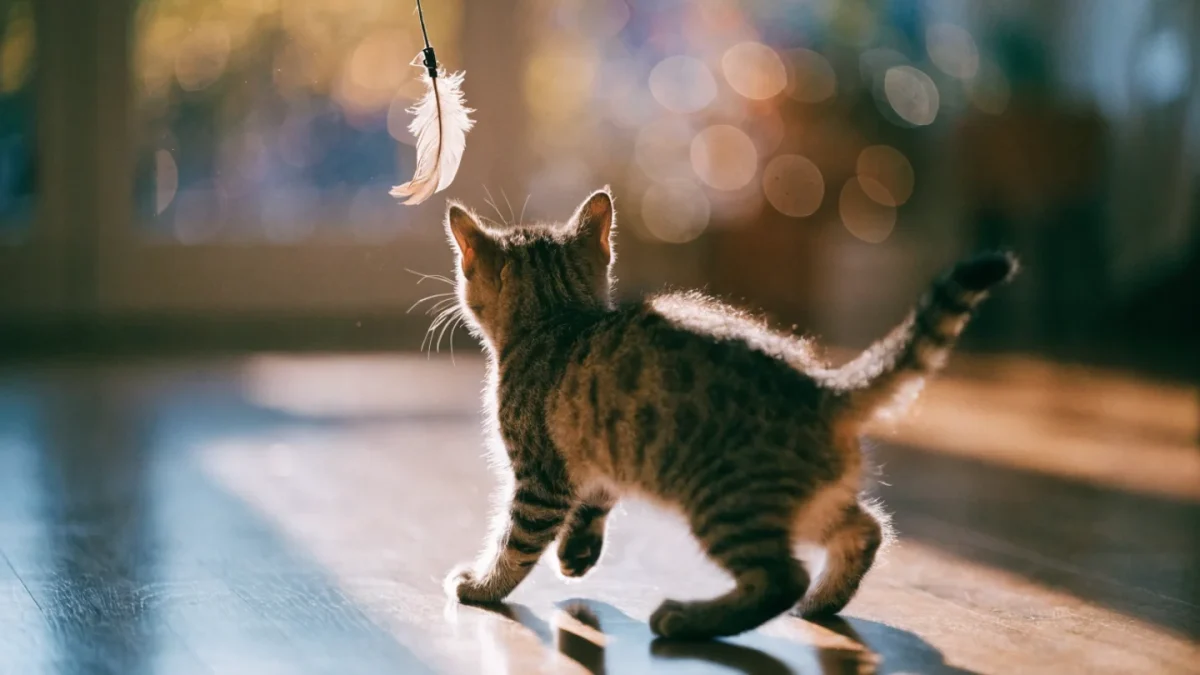
Here's what's actually going on when your kitten latches onto your hand and kicks it with their back legs like you're prey: they're doing exactly what kittens are supposed to do. That doesn't make it less painful. But understanding the why makes the how-to-stop-it part a lot clearer.
My cat Mochi went through a phase around ten weeks old where she would ambush my ankles every single morning. Every. Single. Morning. I'd shuffle to the coffee maker half-asleep and suddenly there were tiny teeth on my Achilles tendon. Adorable in retrospect. Not adorable at 6 a.m.
Kitten play biting is one of the most common things new kitten owners ask about — and also one of the easiest problems to accidentally make worse. The good news: if you catch it early and stay consistent, most kittens grow out of the roughest behavior within a few months.
Why Kittens Bite During Play
Kittens are born hunters. Even before they can see properly, they're batting at things with their paws. By the time they're old enough to play actively, all of that predatory instinct is switched to "on" — and it stays on pretty much permanently for the first year of life.
In a litter, kittens learn bite inhibition naturally. They wrestle, bite each other, and when someone bites too hard, the other kitten yelps, stops playing, or bites back. Through dozens of these tiny exchanges, they calibrate how much pressure is acceptable. It's a self-correcting system.
When a kitten comes home solo — especially before 8 weeks, which is earlier than recommended — they miss a chunk of that learning. Your hands become the most available, most exciting, most wriggly things in the environment. And hands, to a kitten brain, look a lot like prey.
This is why some people accidentally train their kittens to bite harder. If you pull your hand away quickly when a kitten grabs it, you've just replicated the movement of a fleeing animal. The kitten doesn't think "oh, that hurt you" — they think "I caught it, and now it's trying to escape, this is amazing."
For more context on what else to expect during this age, the kitten behavior guide from birth to one year walks through each developmental stage in detail, including when play biting typically peaks and fades.
How to Stop Kitten Play Biting
This is a guide, not a quick fix. Kittens don't un-learn things overnight, and inconsistency will slow you down significantly. The steps below work — but they require everyone in the household doing the same thing.
Step 1: Stop Using Your Hands as Toys
Full stop. No wiggling fingers under blankets. No letting the kitten "gently" gnaw on your knuckles because it's kind of cute. No hand-wrestling. None of it.
This one rule, applied consistently, will do more than anything else on this list. Every time hands become part of the play, you're reinforcing that hands equal prey. The kitten isn't being spiteful — they're learning what you're teaching them.
Substitute a wand toy any time you want to play with your hands. Keep one in every room if you need to. The physical distance a wand toy creates between your hand and the kitten's teeth is the whole point.
Step 2: Redirect Before the Bite Lands
Watch your kitten's body language. A kitten about to bite usually gives signals first: dilated pupils, a low focused crouch, tail tip twitching, that slightly manic sideways-hop. When you see those signs, introduce a toy immediately — before the bite happens.
Timing matters here. Redirecting after the bite has already happened is less effective. You want to give the kitten something appropriate to target while the hunting urge is still building, not after they've already acted on it.
A crinkle ball rolled across the floor, a toy mouse tossed near them, or a wand toy swooped past their head — all of these give the bite somewhere productive to go.
Step 3: End Play the Moment Teeth Touch Skin
When a bite lands anyway (and it will), the response is the same every time: go still, say a calm but firm "no" or "ouch," and disengage immediately. Don't yell, don't flick their nose, don't push them away dramatically. Just… stop being interesting.
Stand up, cross your arms, turn away. If the kitten follows and continues biting at your ankles, leave the room entirely and wait 60 seconds before returning.
This is the kitten equivalent of what littermates do naturally — the game ends when someone bites too hard. You're just stepping into that role. It works because kittens want to play with you. Losing access to you is genuinely aversive for them.
Honestly, the hardest part of this step is staying calm and consistent when a kitten is being absolutely feral at your shins. But reacting with energy — even negative energy — can accidentally reinforce the behavior by making it exciting.
Step 4: Schedule Real Play Sessions
A lot of kitten biting comes from a simple surplus of energy with nowhere to go. Kittens need to hunt. If you're not giving them structured outlets for that, they'll find their own — usually your feet or your hands.
Two 10–15 minute active play sessions a day will do a lot of the heavy lifting here. Use wand toys that let the kitten chase, stalk, pounce, and catch. End each session with a "catch" — let them actually grab and bunny-kick the toy, then wind down gradually rather than stopping abruptly. Abrupt stops leave the kitten wound up with nowhere to put the energy.
Puzzle feeders and solo toys (crinkle balls, springs, toy mice) between sessions help fill the gaps. The goal is a kitten who's pleasantly tired, not bored and overstimulated.
Step 5: Never Punish Physically
Scruffing, spraying with water, tapping the nose — these approaches create a different problem without solving the original one. A kitten who's startled or scared during play doesn't learn "biting is wrong." They learn that you're unpredictable, which erodes trust and can actually increase anxiety-driven biting.
The point isn't to make the kitten afraid. The point is to make biting-you-specifically boring and to make toys exciting. Positive redirection does both of those things. Punishment does neither.
When Play Biting Crosses a Line
Most kitten biting is normal. But occasionally what looks like rough play is actually something else. If you're seeing cat play aggression — sustained growling, hissing combined with biting, biting that breaks skin regularly, or a kitten who seems genuinely reactive rather than playful — it's worth paying closer attention to the triggers.
The real question with any biting problem is: does the kitten engage and then disengage? Or do they escalate and become harder to stop? Normal play biting stops when the game stops. Escalating biting that doesn't respond to redirection is a different conversation.
The Consistency Problem
Look, here's the thing that trips most people up: you can do everything right 90% of the time and still have a kitten who bites, because someone else in the household is doing the hand-wiggling thing 10% of the time. Kittens learn on partial reinforcement. If biting hands sometimes works, they'll keep trying.
Get everyone on the same page. Housemates, family members, visitors who think it's cute when the kitten bites — all of them need to follow the same rules. It sounds exhausting, but the consistency period is usually only a few weeks before the kitten starts defaulting to toys.
Mochi, for the record, is now four years old and has never bitten a human since she was about six months old. She does still occasionally murder a stuffed fish toy at 2 a.m., which I find deeply relatable.
Understanding the socialization window can also help here — kittens who are learning appropriate play behavior during their peak sensitive period absorb these lessons faster than older cats who've been practicing the wrong thing for months.
Frequently Asked Questions
Is it normal for kittens to bite really hard?
Yes, during the peak play biting phase (roughly 8–20 weeks), kittens often bite harder than feels comfortable. They're still calibrating pressure. It usually softens as they get older and learn that lighter bites keep the game going longer.
My kitten only bites me, not other people. Why?
You're probably the most interactive person in their life — the one who plays most, moves around most, and presents the most opportunities. It can also mean you've inadvertently trained them that biting you gets a big reaction. Try being deliberately boring when the biting starts.
Will kittens grow out of biting on their own?
Some do, especially if they have another cat to play with and burn energy on. But many won't fully moderate without some guidance. Left unaddressed, play biting habits developed at 10 weeks can persist into adulthood — and adult cat bites are not small.
What if I have two kittens — does that help?
Usually, yes. Two kittens wrestle each other, bite each other, and learn bite inhibition organically. Human hands become less interesting when there's a littermate to ambush. Getting two kittens is often genuinely easier than getting one — they entertain each other through the wild phase.