

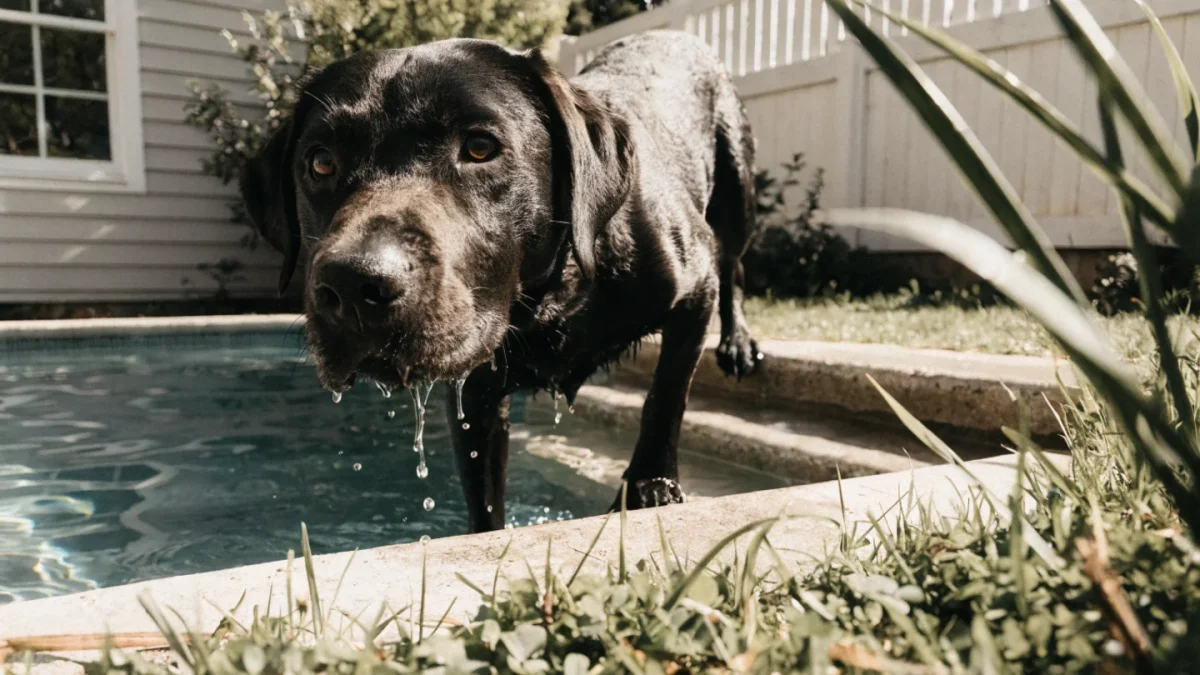
A dog who drowns in a backyard pool almost always could swim. The swimming wasn't the problem.
The problem was the exit. A pool is a smooth-walled container with one or two specific exit points — steps, or a ramp, or a built-in shelf. A dog who doesn't know exactly where those exit points are, when tired and stressed and unable to climb the wall, will swim in circles until they can't anymore.
Exit training is not complicated. It takes one afternoon and maybe a handful of refreshers. And it's the most important pool safety intervention you can make for a dog with pool access.
Before You Start: Assess Your Dog
Is your dog's body type suited to swimming?
Brachycephalic breeds (Bulldogs, French Bulldogs, Pugs, Boston Terriers, Boxers) have compressed airways that make sustained swimming difficult. A French Bulldog can enjoy wading and very brief supervised swim sessions but should never have unsupervised pool access. If you have a brachycephalic breed and a pool, a life jacket is non-negotiable and supervision is constant.
Short-legged, heavy-bodied dogs (Basset Hounds, Dachshunds, Corgis) have biomechanics that make swimming inefficient. They can swim but tire faster than their enthusiasm might suggest.
For any of these dogs: shorter sessions, close supervision, life jacket in deeper water, and pool exit training still applies.
For natural swimmers — Labs, Goldens, retrievers, water dogs — the training is simpler and the independent pool time safer once exit skills are confirmed.
How old is your dog?
Very young puppies aren't ready for pool training — they're still physically developing and can be overwhelmed by the experience. Most dogs can begin positive pool introduction around 8-12 weeks for familiarization (shallow water only), with actual swimming introduction later. Senior dogs with joint issues or cardiac conditions should be checked by a vet before pool swimming.
Teaching Pool Exit: The Protocol
This is the core safety training. Do this before any other pool activity.
What you need:
- A life jacket (correctly fitted for your dog's weight)
- High-value treats
- Patience and a calm energy (your anxiety transfers to the dog)
Session 1: Pool steps familiarization (no swimming yet)
Keep your dog on leash. Walk to the pool steps. Let the dog sniff and investigate. Lure them to put front paws on the top step with a treat, reward, let them step back. Repeat several times. The goal is for the pool steps to be a neutral-to-positive location, not scary.
If the steps are underwater: some pools have the top step at or just below water surface level. That's fine — help the dog understand the steps are there.
End the session before the dog is tired or stressed. Five minutes is enough for the first introduction.
Session 2: Walk the pool perimeter
On leash, walk the dog around the pool perimeter, stopping at the steps and rewarding generously. You're building a spatial map: steps are here, and steps are worth investigating.
Session 3: Guided water entry and step exit
With the life jacket on, gently guide your dog into the water via the steps — support them if needed, don't push or force. Let them feel the water. Then immediately guide them back to the steps and out. Reward enthusiastically.
Do this from the steps. They go in near the steps; they come out using the steps. Repeat this several times.
Session 4: Practicing exit from distance
Now the key skill: with your dog in the water (you in the water too), position yourself near the steps. Call the dog to come to the steps. Reward them for exiting. Move a bit further from the steps each time. The dog learns to navigate to the steps from different distances.
Session 5+: Testing from all pool positions
This is the reliability test. From different positions around the pool — in the water — call the dog and reward them for navigating to the steps. Vary the starting position so they learn to find the exit from any direction, not just the one they practiced.
Proficiency standard: Before trusting pool access, the dog should be able to find and use the exit from any position in the pool, three for three times, without your help.
Introducing Swimming to a Non-Swimmer
Some dogs swim naturally the first time they're in water. Others don't — they panic, they don't move their back legs, they appear to be drowning in a controlled environment with you present. This is normal and fixable.
In shallow water first. An area of the pool where the dog can stand — stairs, a shallow shelf, the first step in water — is the starting point. Let the dog splash around with their feet on the bottom. Positive association with water before anything else.
Support, don't throw. A dog thrown into a pool may learn to swim but learns to associate water with panic. Support their belly under the water initially; let them feel the movement. Many dogs start paddling naturally once they feel supported.
Short sessions. Five minutes, positive experience, out of the pool. Then again tomorrow. You're building confidence, not accomplishing distance.
Life jacket during learning. The jacket provides buoyancy that lets the dog experience being in the water without the immediate need to work hard to stay up. Many dogs relax significantly in a life jacket and start using proper swimming mechanics once the panic is removed.
Pool Equipment to Consider
Dog-specific exit ramps (Skamper Ramp, WaterDog, etc.): These attach to the pool wall and provide a gentle inclined surface from water to deck, including lake river. A dog who knows where this is can use it from anywhere in the pool without needing to find the stairs. Useful as backup to stair training, and as the primary exit for pools without easy stair access.
Life jackets: For supervised pool play — especially for new swimmers, brachycephalic breeds, or dogs in deep water — a correctly fitted life jacket provides meaningful safety margin. The handle on top allows you to lift the dog out if needed.
Pool alarms: Devices that alert when someone enters the pool water. Not a substitute for fencing or training, but an additional layer that alerts you if your dog falls in unexpectedly.
The Ongoing Safety Rules
Exit training is a one-time investment, but pool safety requires ongoing habits:
- Every session requires confirming exit location — don't assume a dog who learned last summer remembers this summer
- Close pool fencing when not in active use — fencing and exit training together, not one or the other
- Supervise all swimming — even strong swimmers can experience cramps, cold water fatigue, or unexpected problems
- Watch for exhaustion signals — heavy panting, labored swimming, repeated failed exit attempts, slow response to recall
- Freshwater rinse after pool swimming — pool chemicals accumulate in coat and can cause skin irritation; rinsing post-swim reduces this
For the full context on all water environments — lakes, rivers, ocean safety, blue-green algae, and waterborne illness — the complete water safety guide for dogs and cats covers everything beyond the pool. And for the physical pool safety infrastructure — barriers and cover options — see pool fencing and cover safety.
FAQ
Q: My dog has been swimming in pools for years with no incidents. Do I still need to do exit training?
If your dog has demonstrated reliable exit behavior — meaning you've seen them navigate to the stairs from across the pool without guidance — they've effectively done the training empirically. If you've never specifically tested whether they can find the exit from any position in the pool, that test is worth doing.
Q: My dog panics when put in the pool. Should I push through the fear?
No. Forced exposure to a feared stimulus increases fear, not confidence. End the session, give it a few days, and start from a less intimidating exposure — letting the dog stand at the pool's edge, then putting just their paws in the water step by step. You want swimming to be a positive experience. A dog who panics in pools probably shouldn't be swimming in them at all, or needs much slower introduction over many sessions.
Q: How do I keep pool chemicals from hurting my dog?
Chlorinated pool water is not harmless — it can irritate eyes and skin with prolonged exposure and cause GI upset if swallowed in quantity. Rinse your dog with fresh water after pool sessions. Ensure pool chemistry is properly balanced (over-chlorinated water is harsher). Don't let dogs drink pool water; bring a fresh water bowl.
Q: Can I let my dog swim in the pool unsupervised after exit training?
Exit training significantly reduces drowning risk, but I wouldn't recommend fully unsupervised pool access for most dogs. An unobserved fall, unexpected exhaustion, or a dog who hasn't refreshed their exit skills recently can still result in a drowning. At minimum, someone should be nearby who can hear if something goes wrong.
Q: What's the right life jacket fit for a dog?
The jacket should allow the dog to breathe comfortably and move all four legs normally. Lift the dog by the handle — their body should remain horizontal, not tip forward or backward significantly. The buoyancy should be in the chest and neck area, keeping the dog's head above water without them needing to work for it. Check manufacturer weight guidelines, but also verify the physical fit on your specific dog.