

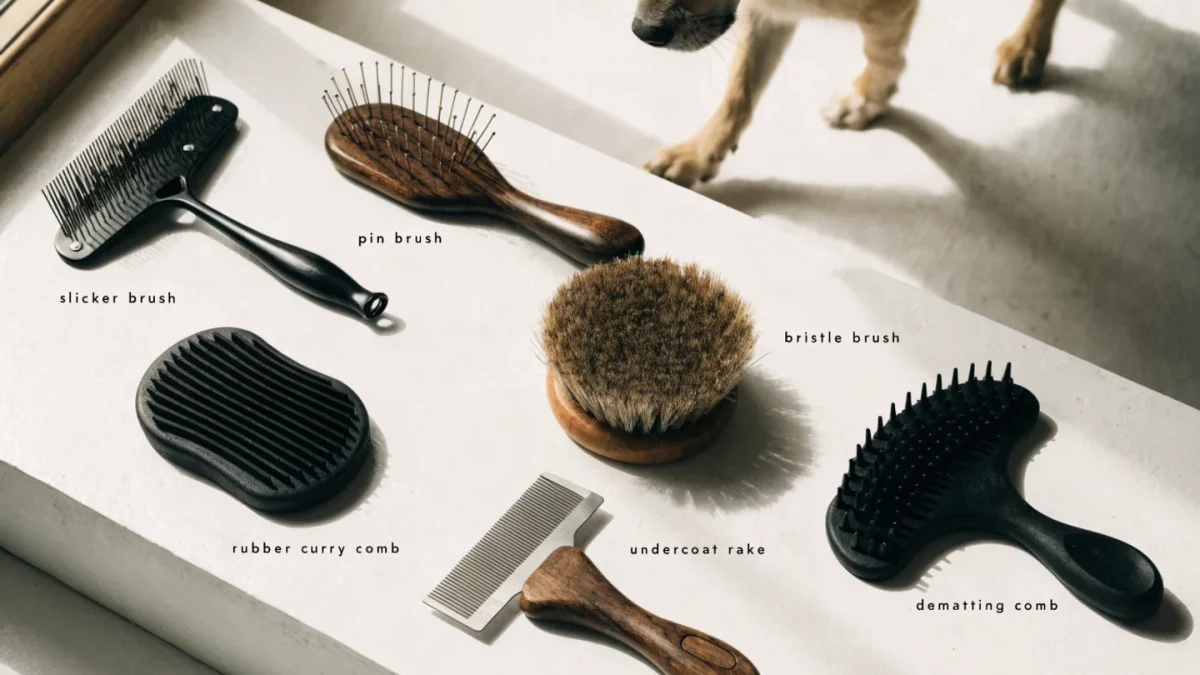
The dog brush aisle at any pet supply store is an exercise in paralysis. Dozens of products, half of which look similar, each claiming to be appropriate for every coat type. The fact that brushes are relatively inexpensive makes it tempting to buy several and figure it out by trial and error. That works. But it wastes money and, more importantly, using the wrong brush means ineffective grooming — mats developing beneath a surface you've just brushed.
This is a functional guide to what each brush type actually does, what it's appropriate for, and how to use it.
The Slicker Brush
The workhorse of modern dog grooming. A slicker has a flat or slightly padded head covered with dense, fine wire tines set at a backward angle (about 45 degrees). Available in a range of head sizes from palm-sized to over four inches wide.
What it does: Removes loose hair from the outer coat, works through light tangles, smooths the coat surface, and — used correctly — lifts and separates coat layers. The angled tines grip loose hair and debris.
Best for:
- Medium to long coats of any type
- Wavy and curly single coats
- Double-coat breeds (outer coat maintenance)
- All coat types during shed season
- Removing loose hair before bathing
Not great for:
- Very short, smooth coats (doesn't have enough to grip)
- Penetrating deep undercoat on thick double-coated breeds without accompanying rake/comb
How to use it: Light to moderate pressure — the tines should bend slightly against the coat, not press hard into the skin. Work in the direction of hair growth in smooth strokes. On longer coats, use line brushing: part the coat, hold back the upper layer, work from the skin upward in sections. On a mat, work from the edge inward, never drag through the center.
What to look for: A comfortable, non-slip handle. Flexible pins in the head base (they should give slightly) rather than a rigid set — this is kinder to skin. Ball-tipped pins on brushes marketed as "gentle" or for sensitive skin are softer but slightly less effective at grabbing loose hair.
The slicker size matters: a 3–4 inch wide head on a Labrador or Golden covers territory efficiently. That same brush on a Chihuahua is awkward. Match head size to dog size.
The Pin Brush
Looks like a traditional human hairbrush: an oval or rectangular head with metal pins set in a cushioned rubber or foam base, usually ball-tipped, spaced considerably farther apart than slicker tines.
What it does: Moves through the coat more gently than a slicker, ideal for flowing, silky, or fragile coats where aggressive wire tines would cause breakage. Works well for fluffing and finishing. Doesn't grip loose hair as aggressively as a slicker.
Best for:
- Long, flowing coats (Afghan Hound, Rough Collie, Irish Setter, Gordon Setter)
- Silky coats prone to breakage (Maltese, Yorkshire Terrier, Shih Tzu)
- Finishing and fluffing after slicker brushing
- Cats with medium to long coats
Not great for:
- Short or smooth coats (not enough to engage with)
- Heavy undercoat removal
- Initial mat work
How to use it: In the direction of hair growth, with moderate strokes. On flowing coats, work from the ends toward the roots when working out tangles — pulling from root to tip through a knot breaks the coat. The pin brush should glide through a well-maintained coat easily.
What to look for: Ball-tipped pins (essential — bare metal points scratch skin). A cushioned base that flexes to follow body contours. Appropriate pin length for coat depth — longer pins for longer coats. Short pins on a long coat don't reach the skin level.
The Bristle Brush
Traditional natural or synthetic bristles on an oval or paddle-shaped head. The finishing brush of the dog grooming world.
What it does: Removes surface dust and fine debris, smooths the coat, stimulates skin oil production, and distributes those oils through the coat. The coat-polishing brush.
Best for:
- Short, smooth coats (Boxer, Vizsla, Beagle, Dalmatian, Weimaraner)
- Final finishing pass on any coat type after slicker/pin work
- Daily quick maintenance between thorough sessions
Not great for:
- Penetrating medium or long coats (bristles don't reach skin level)
- Removing loose undercoat
- Mat work
How to use it: Short strokes in the direction of hair growth. On smooth coats, this is often the primary brush — 5 minutes with a bristle brush removes loose hair and leaves the coat gleaming. On longer coats, use it last for finishing.
What to look for: Firm natural bristles (boar bristle is traditional and excellent for polish) for short, coarse coats. Softer bristles for fine coats or sensitive skin. Natural bristles hold static better and distribute oils more effectively than synthetic.
Rubber Curry Combs and Grooming Mitts
Rubber tools with molded nubs or tines — either handheld ovals designed to be held in the palm or mitts that slip over the hand.
What they do: Remove loose hair from short to medium smooth coats, stimulate skin circulation, work shampoo into the coat during bathing, and provide a massage-like sensation that most dogs accept readily (often more readily than traditional brushes).
Best for:
- Short single-layer coats of any breed
- Bath time massage and shampoo work
- Dogs who resist traditional brushes
- Daily quick maintenance between sessions
- Puppies being introduced to grooming
Not great for:
- Long or thick coats (rubber doesn't penetrate)
- Mat removal
- Undercoat management
How to use it: Circular strokes with moderate pressure. During bathing, circular motions work shampoo into the coat and stimulate the skin effectively. Between baths, stroke in the direction of hair growth to collect loose hair on the rubber.
Mitts vs handheld: The mitt leaves both hands free in a sense — you can pet the dog while grooming, which many dogs perceive as affection rather than handling. Good for less cooperative dogs.
Undercoat Rakes
Long-tined tools (the tines are spaced farther apart than a comb) designed to reach through the outer coat and work through the undercoat. Available with single or double rows of tines, sometimes with rotating heads.
What they do: Break apart packed undercoat, remove loose undercoat in bulk during shed season, prevent mat formation at the undercoat level.
Best for:
- Dense double-coated breeds during shed season (Husky, Malamute, Chow Chow, Akita)
- Any double-coated breed during routine maintenance
- Thick-coated cats (Maine Coon, Norwegian Forest Cat)
How to use it: Work with the hair growth direction, moderate pressure. Don't apply excessive force — a rake pulled hard through a tangled undercoat pulls on skin. Use a detangling spray if the undercoat is resisting. If your grooming program also involves clipper work, the dog grooming clippers guide explains motor types, blade systems, and which clippers suit different coat types.
Dematting Combs
Specialized tools with curved, separated tines or blade edges designed to break apart mats progressively. The tines often have a sharp edge that cuts through mat structure.
What they do: Break apart mats without requiring complete cutting or shaving. A step up from standard combing for established mats.
Best for:
- Working through established mats before they require shaving
- Coats that mat regularly (Poodles, Bichons, Doodles)
Important: These tools do some cutting. They should not be used near the skin on tight, close-to-body mats — the risk of nicking skin is real. Always hold the mat at the base to avoid pulling on the skin.
How to Match Brush to Dog
| Coat Type | Primary Brush | Secondary Tool | Finishing |
|---|---|---|---|
| Short smooth (Boxer, Vizsla) | Rubber curry or bristle | Fine comb | Bristle brush |
| Medium smooth (Labrador) | Slicker | Undercoat rake | Bristle brush |
| Double coat, thick (Husky, Akita) | Slicker + undercoat rake | Wide-tooth comb | Pin brush |
| Long flowing (Collie, Setter) | Pin brush | Slicker (dense areas) | Fine comb |
| Curly/wavy (Poodle, Bichon) | Slicker | Fine steel comb | — |
| Silky, fragile (Maltese, Yorkie) | Pin brush | Fine comb | Bristle |
| Short coat cat | Fine comb or slicker | Flea comb | — |
| Semi-longhair cat | Slicker or pin brush | Wide steel comb | — |
A steel comb is not in the "brush" category but belongs in every kit as the checkpoint. After brushing, run a comb from skin to tip. If it catches anywhere, the brush hasn't done its job in that spot.
The Testing Approach
The ideal approach to choosing brushes — especially for a dog with an unusual coat type or a rescue with unknown coat history — is to start with the most appropriate brush based on coat length and texture, then assess results. If the slicker is reaching the undercoat and the comb passes freely post-brushing, you've found your tool. If the comb still catches, try a longer-pin slicker or add an undercoat rake to the process.
The goal isn't the most tools. It's the right tools for the specific coat.
For a complete overview of all grooming equipment categories, see the pet grooming tools and equipment guide. For clippers and cutting tools, see the dog grooming clippers guide.