

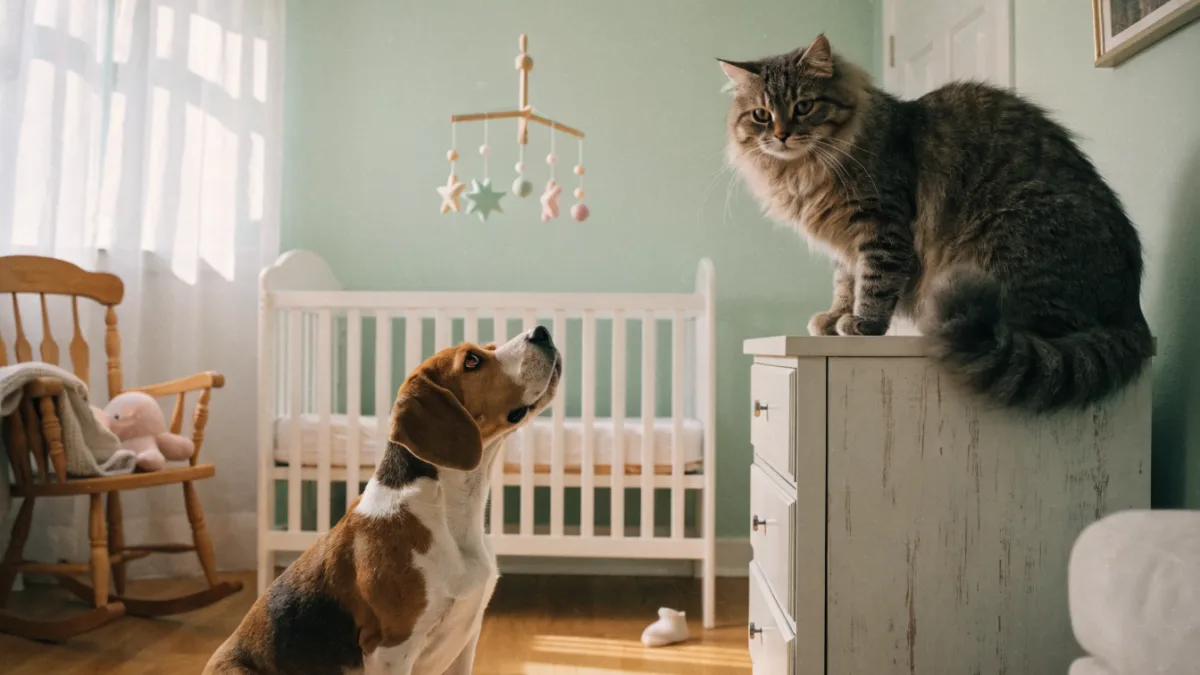
When my sister brought her newborn home last year, I watched her golden retriever, Biscuit, press his entire 75-pound body against her leg like a furry barnacle, while her tabby cat, Pickles, disappeared into the basement closet and refused to emerge for three full days. Same household, same baby, completely opposite reactions — and honestly, the clearest illustration I’ve ever seen of why “preparing your pets for baby” is not a one-size-fits-all project.
Here’s the thing nobody tells you: dogs and cats process the arrival of a new human through entirely different emotional frameworks. Dogs get jealous. Cats get territorial. And if you try to address both with the same strategy, you’ll end up with a confused dog, an offended cat, and a whole lot of stress you could have avoided.
The Jealous Dog: It’s About the Pack
Dogs are pack animals, which means they’re hardwired to care about where they rank in the family structure — and more importantly, where your attention goes. When a baby arrives, your dog doesn’t think “oh good, a tiny human.” Your dog thinks “why is that loud potato getting all the belly rubs.”
The American Veterinary Medical Association has found that most dog bites to infants come from the,[1] not some unfamiliar animal on the street. And the triggers are almost always predictable: resource guarding, startle responses when woken suddenly, and good old-fashioned jealousy. It’s not that your dog is malicious — it’s that your dog is confused, and confusion in a pack animal often looks like acting out.
A friend’s Labrador started stealing the baby’s socks in the weeks after they brought their daughter home. Not to chew them — just to collect them in a pile on his bed. It seemed almost cute until a behaviorist pointed out that this was classic resource-guarding displacement. He was hoarding something because he felt like everything else was being taken away.
Jake would tell you — and has told me, at length, because that’s what happens when you live with a dog trainer — that the key with dogs isn’t teaching them to avoid the baby. It’s teaching them that the baby’s presence means good things happen. The old approach of scolding a dog for getting close to the infant? That just teaches the dog that baby equals punishment, which is the exact wrong association and a fast track to increased anxiety and aggression.
The Territorial Cat: It’s About the Space
Now let’s talk about cats, because cats are a completely different game.
First, let’s deal with the old wives’ tale: your cat is not going to suck your baby’s breath. I don’t know who started this rumor, but it’s been haunting cat owners for generations, and it’s absolute nonsense. Cats don’t have some mystical vendetta against infants.
What cats do have is an intense, almost obsessive relationship with their territory. Your cat doesn’t care that the baby is getting more cuddle time — your cat cares that there’s a new piece of furniture in the room where she used to nap, that the door to the nursery is suddenly closed, and that the house smells weird. Territory, for a cat, is about predictability and control over environment. A baby dismantles both.
My cat Mochi has never forgiven me for rearranging the living room furniture, and that was three years ago with no baby involved. I can only imagine what she’d do if I brought home a screaming human and started closing doors she’s used to walking through.
When my neighbor had her first baby, her cat started spraying the stroller. Not because he was jealous of the attention — because the stroller was an intruder in his space and he was making a territorial statement. Classic cat logic: if it’s new and it exists in my house, I will mark it.
The real physical risk cats pose to infants is the crib situation. Cats gravitate toward warm, soft, elevated spaces, and a crib mattress checks every box. The solution is practical: set up the crib early, make it unappealing as a cat lounge, and consider keeping the nursery off-limits or using a crib net. Aluminum foil or double-sided tape on the crib mattress works remarkably well — cats despise both textures and will abandon ship after one test landing.
Start Early — Like, Really Early
Both dogs and cats are creatures of habit, and the sudden disruption of routine is the single biggest stressor for pets when a baby arrives. This means preparation isn’t something you do the weekend before your due date. It’s a slow, deliberate process that should ideally begin months in advance.
Rewrite the Routine Gradually
If your dog is used to a 7 AM walk and you know that’s going to shift once the baby arrives, start shifting it now. Gradually. Over weeks. If your cat’s feeding schedule will change because you’ll be occupied, adjust it incrementally. The goal is for the new routine to feel boring and normal long before the baby ever appears.
Condition the Senses
This is where it gets interesting. Start wearing baby lotion on your hands before petting your animals. If you can get a blanket from the hospital carrying the baby’s scent before you bring the baby home, do it — let your pets investigate and reward calm sniffing.
And then there’s the noise. If you’ve never heard a newborn cry at close range, let me prepare you: it is a lot. Play recordings of babies crying — you can find these easily online — at low volume while your pets are eating or getting treats. Gradually increase the volume over weeks. You’re not trying to make them indifferent; you’re teaching them that baby sounds predict good things.
Furniture First
Set up the crib, the swing, the bouncy seat, the stroller — all of it — well before the baby arrives. Let your pets investigate. For cats, this is especially critical. New furniture in their territory is far less threatening if it’s been sitting there, collecting dust and smelling like the house, for months. Let your cat realize the crib is boring before it becomes a competition for warmth.
The Homecoming: Who Comes First
Here’s something that surprised me watching my sister: the pets didn’t care about the baby. They cared about her. She’d been gone for a few days, and when she walked through that door, Biscuit nearly took her out at the knees and Pickles — from the safety of the hallway — meowed like she’d been gone for a decade.
The recommendation from every behaviorist I’ve spoken with is the same: whoever has been away should greet the pets empty-handed first. No baby, no car seat, no distractions. Just a genuine reunion.
Then, once the initial excitement settles, bring in the baby for a calm, controlled introduction. For dogs, that means on a leash, ideally with a second person handling the dog while the primary caregiver holds the baby. Reward calm behavior with high-value treats — the really good, stinky stuff. This is not a dry kibble moment.
For cats, don’t force it. Open the door and let them approach on their own timeline. If Pickles wants to sniff the baby’s foot from four feet away and then retreat, that’s a successful introduction. If she wants nothing to do with it today, fine. Cats need to feel they have agency, and forcing contact will only confirm that this new creature is bad news.
The “Pandemic Pet” Variable
One thing worth noting: if you adopted your pet during the pandemic lockdowns, this transition may be particularly rough. These animals were socialized in a quiet, isolated environment with near-constant human presence. They’ve never known a chaotic household, unpredictable schedules, or divided attention. They’re essentially starting from scratch when it comes to tolerating disruption.
This doesn’t mean they can’t adjust — it just means they may need more time, more patience, and possibly more professional support. The [2] right now confirm what behaviorists are seeing: pandemic pets often have a harder time with life transitions, and baby-related ones in particular.
When to Call for Backup
I want to be honest about something: sometimes, despite your best efforts, the integration doesn’t go smoothly. And that’s not a personal failure.
If your dog shows signs of resource guarding around the baby — stiffening, hard staring, growling, or fixating — get professional help immediately. This is beyond general training. You want a certified applied animal behaviorist or a veterinary behaviorist. The good news? Thanks to telehealth, you no longer need to find one locally. Virtual consultations have made expert help accessible to almost anyone with an internet connection.
If your cat stops eating, stops using the litter box, or starts spraying, talk to your vet first to rule out medical causes, then work with a behaviorist on environmental management.
And here’s the conversation nobody wants to have but I think needs saying: sometimes, rehoming is the right and kindest choice. If a dog shows severe, unmanageable aggression toward an infant, or if a cat becomes so stressed that her health is deteriorating, keeping them in that environment isn’t noble. It’s risky for the baby and genuinely miserable for the animal. [3] are the ones who felt guilty for even considering it. Every situation is individual, and a qualified professional can help you navigate that decision without shame.
Here’s what I keep coming back to: your pets don’t know what’s about to happen. They can’t prepare themselves. The dog who has slept at the foot of your bed for four years doesn’t understand why there’s suddenly a gate across the doorway. The cat who claimed the sunny corner of what is now the nursery doesn’t know why she’s been exiled from her favorite spot. Preparing your pets for a baby isn’t just logistics — it’s an act of care for the animals who were your family first. It takes patience, planning, and sometimes professional guidance. But when your dog finally lies down calmly beside the bassinet, or your cat deigns to nap in the same room as the baby without complaint, you’ll understand why every minute of preparation was worth it. The bond between a child and the family pet is one of life’s quiet gifts — and like most good things, it starts with doing the unglamorous work ahead of time.
Sources
- family dog — aspca.org
- conversations happening in parenting communities — reddit.com
- The parents I've seen struggle most — facebook.com